How to Write Korean: The Complete Hangul Stroke Order Guide
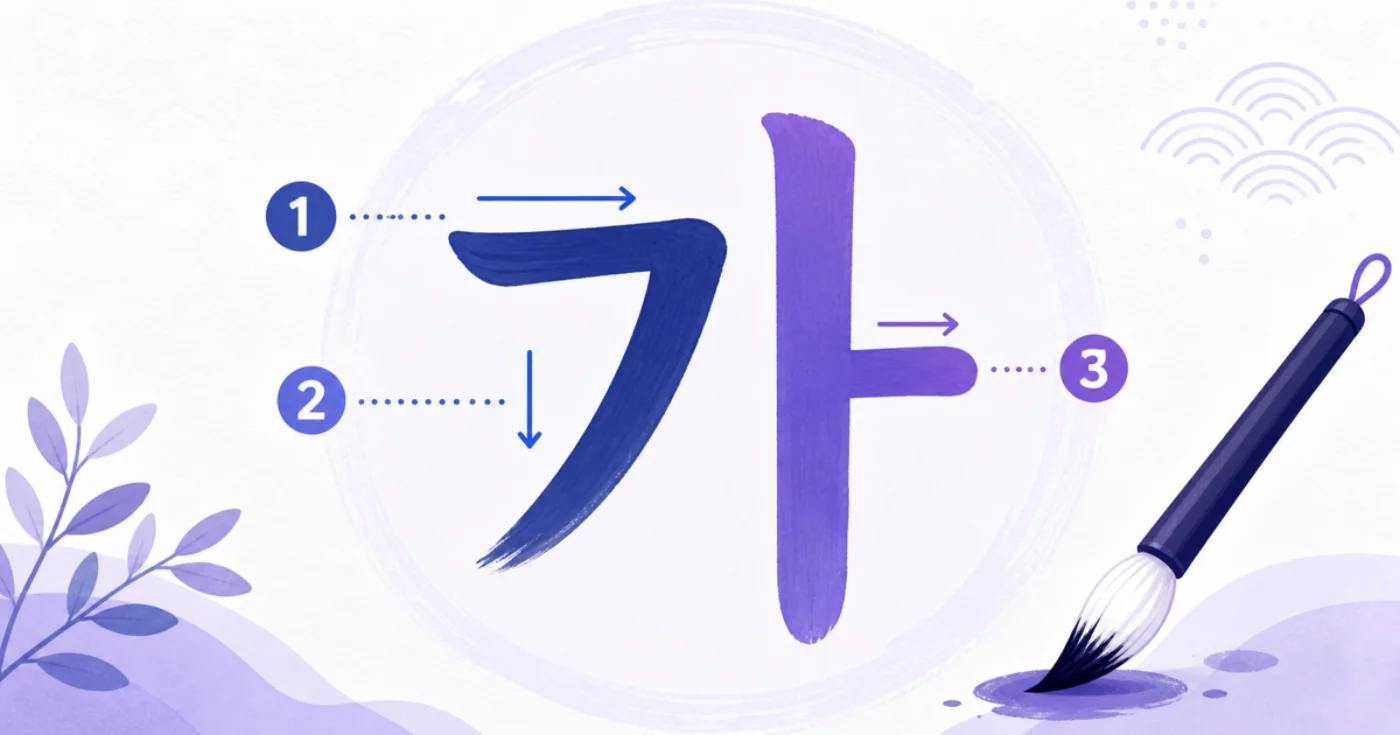
Why Stroke Order Matters
When learning to write Korean, many beginners focus only on making the character look right — but stroke order matters just as much as the final shape. Correct stroke order helps you write faster, more naturally, and with better proportions. It also builds muscle memory that makes handwriting feel effortless over time.
Think of it like learning to tie your shoes: there's a specific sequence that becomes automatic with practice. Korean stroke order follows consistent rules that apply across all 24 basic characters (자모, jamo), so once you learn the patterns, you can apply them to any character.
HangeulMate's Writing Practice feature lets you trace each character with animated stroke guides, then write freehand and get instant scoring. Try it at hangeulmate.com/writing!
The 3 Golden Rules of Korean Stroke Order
Korean stroke order follows three simple rules that cover almost every character:
- Top to bottom (위에서 아래로) — Start from the top of the character and work your way down.
- Left to right (왼쪽에서 오른쪽으로) — Horizontal strokes go from left to right. When a character has both vertical and horizontal elements, the leftmost stroke usually comes first.
- Horizontal before vertical — When strokes cross, the horizontal stroke is typically written first.
These three rules will guide you through 90% of all Korean characters. Let's see how they apply to each consonant and vowel.
Korean Consonants (자음) — Stroke Order
Korean has 14 basic consonants. Here's the correct stroke order for each one, with the number of strokes listed.
Simple Consonants (2-3 strokes)
| Character | Name | Strokes | Order |
|---|---|---|---|
| ㄱ | Giyeok (기역) | 2 | ① Horizontal right → ② Vertical down |
| ㄴ | Nieun (니은) | 2 | ① Vertical down → ② Horizontal right |
| ㄷ | Digeut (디귿) | 3 | ① Horizontal right → ② Vertical down → ③ Horizontal right |
| ㄹ | Rieul (리을) | 5 | ① Horizontal → ② Down → ③ Horizontal → ④ Down → ⑤ Horizontal |
| ㅁ | Mieum (미음) | 4 | ① Left vertical → ② Top horizontal → ③ Right vertical → ④ Bottom horizontal |
| ㅂ | Bieup (비읍) | 4 | ① Left vertical → ② Right vertical → ③ Middle horizontal → ④ Bottom horizontal |
| ㅅ | Siot (시옷) | 2 | ① Left diagonal → ② Right diagonal |
| ㅇ | Ieung (이응) | 1 | ① Circle (counterclockwise from top) |
| ㅈ | Jieut (지읒) | 3 | ① Horizontal → ② Left diagonal → ③ Right diagonal |
| ㅊ | Chieut (치읓) | 4 | ① Top short stroke → ② Horizontal → ③ Left diagonal → ④ Right diagonal |
| ㅋ | Kieuk (키읔) | 3 | ① Horizontal → ② Vertical down → ③ Middle horizontal |
| ㅌ | Tieut (티읕) | 4 | ① Top horizontal → ② Left vertical → ③ Middle horizontal → ④ Bottom horizontal |
| ㅍ | Pieup (피읖) | 4 | ① Left vertical → ② Top horizontal → ③ Right vertical → ④ Bottom horizontal |
| ㅎ | Hieut (히읗) | 3 | ① Top short stroke → ② Horizontal → ③ Circle |
Key Patterns to Notice
- Box-shaped characters (ㅁ, ㅂ, ㅍ) always start with the left vertical stroke.
- Characters with a top horizontal line (ㄱ, ㄷ, ㅋ, ㅌ) start there first.
- ㅇ is unique — it's a single circle drawn counterclockwise starting from the top.
- Characters with diagonal strokes (ㅅ, ㅈ, ㅊ) draw diagonals after any horizontal lines.
Korean Vowels (모음) — Stroke Order
Korean has 10 basic vowels. Vowels are simpler than consonants — most have just 1-3 strokes.
| Character | Name | Strokes | Order |
|---|---|---|---|
| ㅏ | A (아) | 2 | ① Vertical line → ② Short horizontal right |
| ㅑ | Ya (야) | 3 | ① Vertical line → ② Upper horizontal right → ③ Lower horizontal right |
| ㅓ | Eo (어) | 2 | ① Short horizontal left → ② Vertical line |
| ㅕ | Yeo (여) | 3 | ① Upper horizontal left → ② Lower horizontal left → ③ Vertical line |
| ㅗ | O (오) | 2 | ① Short vertical up → ② Horizontal line |
| ㅛ | Yo (요) | 3 | ① Left vertical up → ② Right vertical up → ③ Horizontal line |
| ㅜ | U (우) | 2 | ① Horizontal line → ② Short vertical down |
| ㅠ | Yu (유) | 3 | ① Horizontal line → ② Left vertical down → ③ Right vertical down |
| ㅡ | Eu (으) | 1 | ① Horizontal line |
| ㅣ | I (이) | 1 | ① Vertical line |
Vowel Pattern: The "Stick and Branch" Rule
Korean vowels are built from a simple system: a main line (the "stick") with shorter branches. The stick is either vertical (ㅏ, ㅑ, ㅓ, ㅕ, ㅣ) or horizontal (ㅗ, ㅛ, ㅜ, ㅠ, ㅡ). Branches point right/up for bright vowels (양성모음: ㅏ, ㅑ, ㅗ, ㅛ) and left/down for dark vowels (음성모음: ㅓ, ㅕ, ㅜ, ㅠ).
Bright vowels (ㅏ, ㅗ) have branches pointing right or up toward the sky. Dark vowels (ㅓ, ㅜ) point left or down toward the earth. This "bright/dark" distinction also matters for Korean vowel harmony in grammar!
Combining Characters into Syllable Blocks
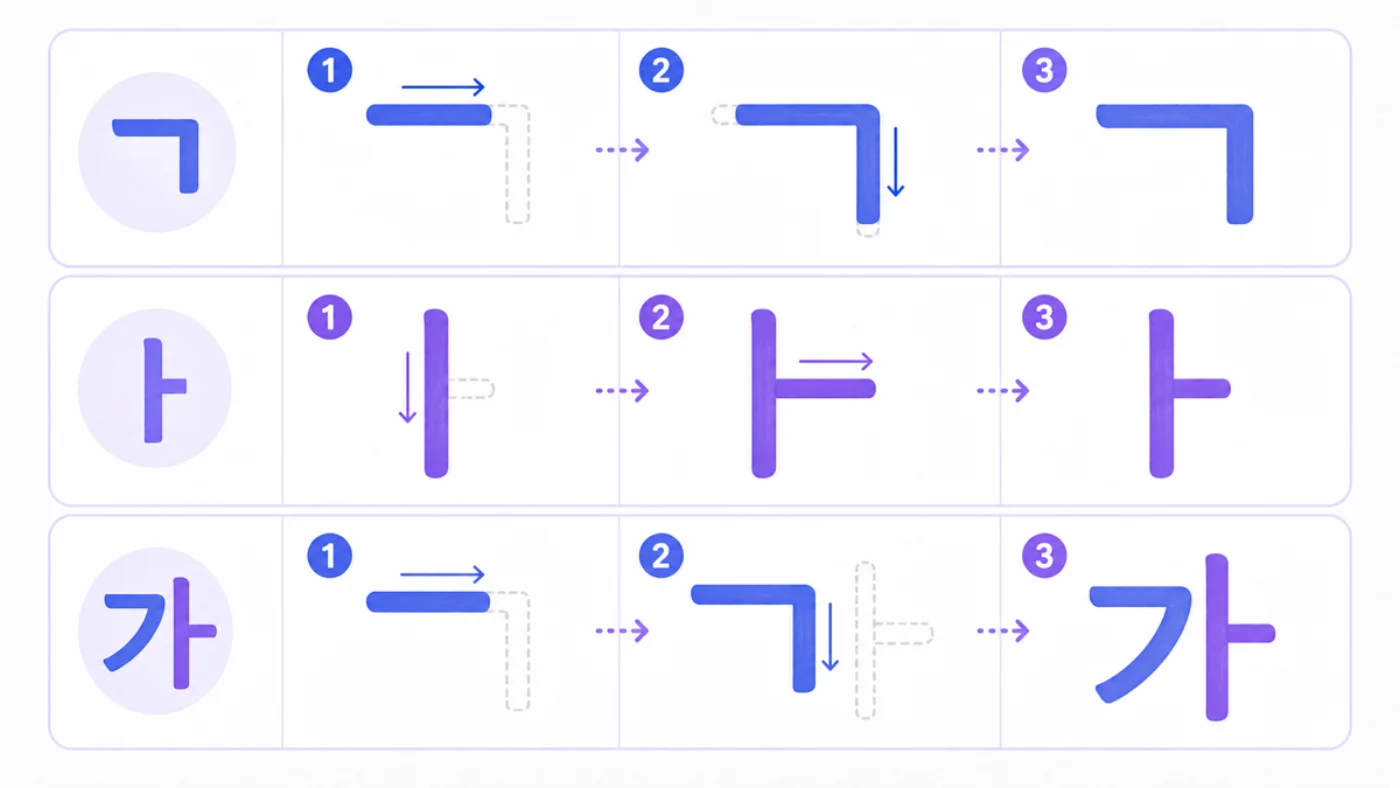
Korean characters are written in syllable blocks, not in a line like English. Each block combines a consonant + vowel (+ optional final consonant). The stroke order within a block follows these principles:
- Write the initial consonant (초성) first
- Then the vowel (중성)
- Then the final consonant (받침) if there is one
- Within each component, follow the stroke order rules above
Common Stroke Order Mistakes
Even dedicated learners make these common mistakes when writing Korean:
- Writing ㄴ starting with the horizontal line instead of the vertical — always start from the top!
- Drawing ㅇ clockwise — the standard is counterclockwise from the top.
- Starting ㅂ with the middle horizontal line — the two vertical lines come first.
- Writing ㅁ by drawing a box in one stroke — it's four separate strokes.
- Forgetting that ㄹ has 5 strokes — it's the most complex basic consonant.
Tips for Practicing Hangul Writing
- Start with tracing: Follow a guide to build muscle memory before writing freehand.
- Practice in groups: Learn consonants and vowels in related sets (e.g., ㄱ/ㅋ, ㄷ/ㅌ).
- Use grid paper: Korean characters should fit in a square. Grid paper helps with proportions.
- Write slowly at first: Speed comes naturally once the stroke order is automatic.
- Practice daily: Even 5 minutes of daily writing practice is better than one hour per week.
Ready to practice? HangeulMate's free Writing Practice feature includes animated stroke order guides for all 24 characters, a drawing canvas with instant scoring, and both trace and copy modes. Start practicing at hangeulmate.com/writing
From Characters to Words: Next Steps
Once you've mastered the stroke order for all 24 basic characters, you're ready to write any Korean word! Start with simple syllable blocks and gradually work your way up to full sentences. The muscle memory you build now will serve you for years to come.
Remember: beautiful handwriting isn't the goal at first — correct stroke order and consistent practice are. The beauty will come naturally as your confidence grows.
Write and Hear Together
Writing sticks faster when you connect each shape to its sound. As you practice stroke order, tap to hear how each character sounds, then write it while saying it aloud -- linking the hand, the eye, and the ear.
Quick Check: Stroke Order
1. What is the general direction for writing Hangul strokes?
2. Within a syllable block, which part do you write first?
3. Why does correct stroke order matter for beginners?
Keep practicing with native-speaker audio
Every word is recorded by a native Korean speaker — tap to listen, free and without signing up.
Start Learning Korean Today
Master Hangul in 7 days with interactive lessons, AI conversation practice, and spaced repetition. 100% free to start.
Get Started FreeRelated Articles
What Is Hangul? The Complete Guide to the Korean Alphabet
Discover Hangul, the Korean alphabet created by King Sejong in 1443. Learn why it's considered one of the most scientific writing systems ever invented.
How to Read Korean in 30 Minutes: A Beginner's Quick Start
Learn to read Korean in just 30 minutes with this step-by-step guide. Master basic consonants, vowels, and syllable blocks with pronunciation tips.
Korean Handwriting vs Typing: Why Writing by Hand Helps You Learn Faster
The research on why handwriting Hangul accelerates memory, recognition, and fluency — plus a practical schedule for when to write by hand and when to type.