How to Read Korean in 30 Minutes: A Beginner's Quick Start
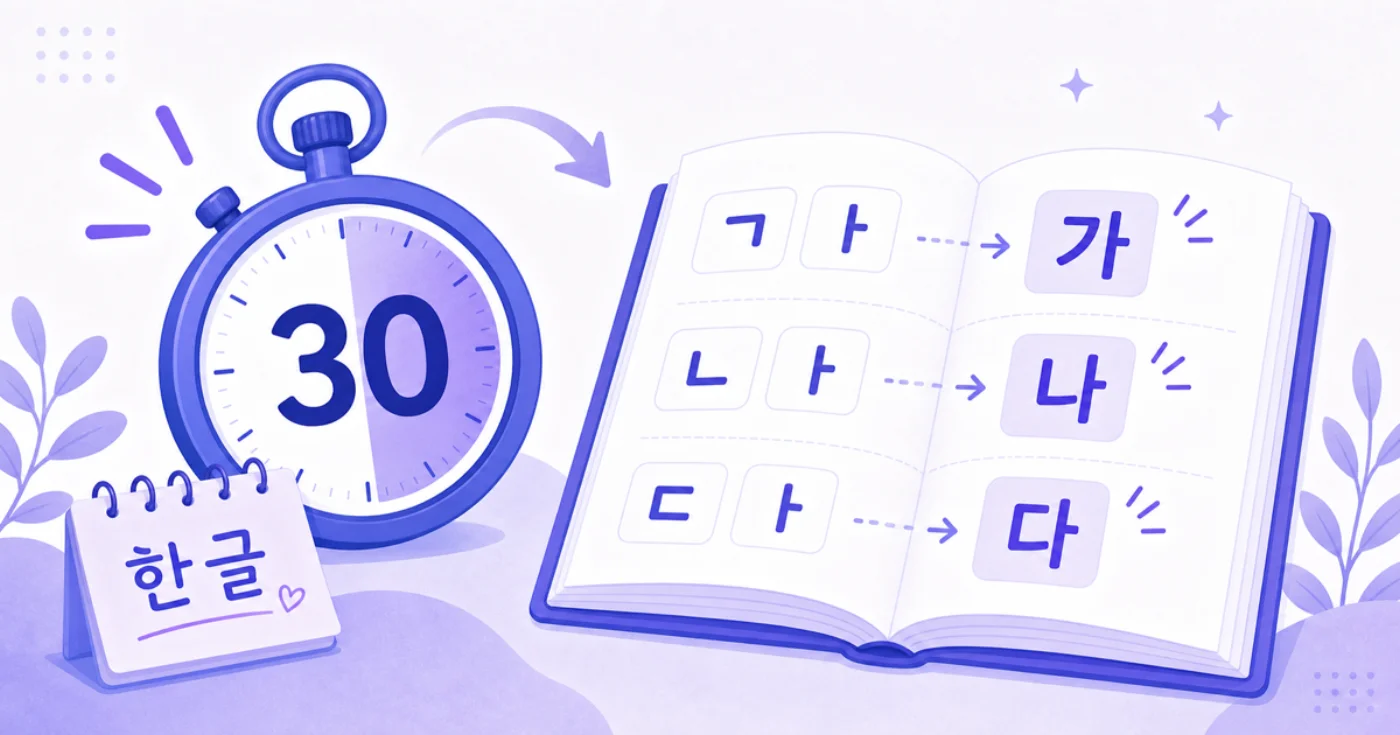
Yes, You Really Can Read Korean in 30 Minutes
Korean might look intimidating at first glance, but here is a secret that surprises most people: the Korean alphabet, Hangul, was specifically designed to be easy to learn. King Sejong created it in 1443 so that ordinary citizens -- not just scholars -- could become literate. The system is so logical that you can learn to sound out Korean text in a single sitting. This guide walks you through the essential consonants, vowels, and syllable-building rules you need to start reading real Korean words today.
You do not need to memorize everything perfectly on the first pass. The goal is to understand the system. Once you grasp how the letters combine, reading practice will reinforce your memory naturally.
Step 1: Learn the 6 Basic Vowels (Minutes 1-8)
Korean vowels are drawn using vertical lines, horizontal lines, and short strokes. Start with these six -- they are the foundation for every Korean syllable. When a vowel starts a syllable on its own, it is always paired with the silent consonant ㅇ as a placeholder.
| Letter | Romanization | Pronunciation | Memory Tip |
|---|---|---|---|
| ㅏ | a | ah (as in "father") | Vertical line with stroke to the right -- mouth opens wide |
| ㅓ | eo | uh (as in "son") | Vertical line with stroke to the left -- mouth less open |
| ㅗ | o | oh (as in "go") | Horizontal line with stroke going up |
| ㅜ | u | oo (as in "moon") | Horizontal line with stroke going down |
| ㅡ | eu | uh (spread lips, say "uh") | A single horizontal line -- lips are flat and spread |
| ㅣ | i | ee (as in "see") | A single vertical line -- like the letter "i" without the dot |
A simple rule to remember direction: if the short stroke points right or up, the sound is brighter (ㅏ "ah", ㅗ "oh"). If it points left or down, the sound is darker (ㅓ "uh", ㅜ "oo"). This bright/dark vowel distinction is important in Korean grammar too.
Step 2: Learn the 9 Essential Consonants (Minutes 8-18)
Now add nine consonants. Each one has a consistent sound, and many of the shapes hint at how your mouth moves when you say them. These nine consonants plus the six vowels above let you read the vast majority of basic Korean words.
| Letter | Romanization | Sound | Memory Aid |
|---|---|---|---|
| ㄱ | g/k | g as in "go" (soft) | Looks like a corner -- the back of your tongue lifts |
| ㄴ | n | n as in "no" | Looks like the top-left of the letter N |
| ㄷ | d/t | d as in "do" (soft) | ㄴ with a line on top -- tongue in the same spot, but closed |
| ㄹ | r/l | between r and l | A flowing shape for a flowing sound -- tap of the tongue |
| ㅁ | m | m as in "mom" | Looks like a box -- your mouth closes completely |
| ㅂ | b/p | b as in "buy" (soft) | Looks like a bucket -- lips come together |
| ㅅ | s | s as in "sun" | Looks like a tree or a hat -- air flows over your tongue |
| ㅇ | silent / ng | silent at start, "ng" at end | A circle -- zero sound at the beginning of a syllable |
| ㅈ | j | j as in "just" | ㅅ with a line on top -- related sound, slightly stronger |
Step 3: Build Your First Syllable Blocks (Minutes 18-25)
Here is where the magic happens. Korean letters do not sit in a straight line like English. Instead, they stack together into syllable blocks. Every block follows a simple formula: start with a consonant, add a vowel, and optionally finish with another consonant at the bottom (called batchim).
Pattern 1: Consonant + Vertical Vowel (Left-Right)
When the vowel is vertical (ㅏ, ㅓ, ㅣ), the consonant sits to the left and the vowel sits to the right.
Pattern 2: Consonant + Horizontal Vowel (Top-Bottom)
When the vowel is horizontal (ㅗ, ㅜ, ㅡ), the consonant sits on top and the vowel goes underneath.
Pattern 3: Adding a Final Consonant (Batchim)
A third consonant can be placed at the bottom of the block. This final consonant is called batchim (받침, literally "support"). It closes the syllable.
Step 4: Practice With Real Words (Minutes 25-30)
Now put it all together. Try sounding out these common Korean words using only the letters you have learned. Cover the romanization column and see how many you can decode on your own.
Bonus: The Remaining Letters
The nine consonants and six vowels above cover the most common sounds, but Hangul has a few more letters to complete the system. Once you are comfortable with the basics, add these to your knowledge.
Aspirated Consonants
These are stronger versions of consonants you already know. They are pronounced with a noticeable puff of air.
| Letter | Sound | Base Letter |
|---|---|---|
| ㅋ | k (strong, aspirated) | ㄱ + extra stroke |
| ㅌ | t (strong, aspirated) | ㄷ + extra stroke |
| ㅍ | p (strong, aspirated) | ㅂ + extra stroke |
| ㅊ | ch (strong, aspirated) | ㅈ + extra stroke |
| ㅎ | h (breathy) | Unique -- represents breath from the throat |
Y-Vowels
Adding an extra short stroke to a basic vowel creates a "y-" sound at the beginning. If you already know ㅏ (a), then ㅑ is simply "ya."
| Base Vowel | Y-Vowel | Sound |
|---|---|---|
| ㅏ (a) | ㅑ (ya) | yah |
| ㅓ (eo) | ㅕ (yeo) | yuh |
| ㅗ (o) | ㅛ (yo) | yoh |
| ㅜ (u) | ㅠ (yu) | yoo |
What to Do Next
Congratulations -- you now understand the core system behind Korean writing. You know how consonants and vowels combine into syllable blocks, and you can sound out basic words. The next step is practice. Read Korean signs, food packaging, or song lyrics. The more you read, the faster the letters will become automatic.
- Practice writing each letter by hand to build muscle memory
- Sound out Korean text you encounter in daily life (restaurant menus, product labels, K-drama subtitles)
- Use spaced repetition to review letters you find difficult
- Learn the double consonants (ㄲ, ㄸ, ㅃ, ㅆ, ㅉ) once you are comfortable with the basics
- Start learning basic vocabulary -- attaching meaning to sounds accelerates retention
Read These Words Aloud
Here is the real test: can you read these words before tapping play? Each one uses only the letters you just learned. Sound it out first, then play the native speaker to check yourself. This is exactly how reading becomes automatic.
HangeulMate teaches every Hangul letter through interactive lessons with native-speaker audio, stroke animations, and spaced repetition review. Level 0 covers the complete alphabet from basic vowels to complex batchim, and most learners finish it within a few days.
Quick Check: Can You Read These?
1. In a Korean syllable block, where does the first consonant always go?
2. The word 산 is read as "san". What does the bottom letter ㄴ represent?
3. Why can most people learn to read Hangul in about 30 minutes?
Keep practicing with native-speaker audio
Every word is recorded by a native Korean speaker — tap to listen, free and without signing up.
Start Learning Korean Today
Master Hangul in 7 days with interactive lessons, AI conversation practice, and spaced repetition. 100% free to start.
Get Started FreeRelated Articles
What Is Hangul? The Complete Guide to the Korean Alphabet
Discover Hangul, the Korean alphabet created by King Sejong in 1443. Learn why it's considered one of the most scientific writing systems ever invented.
15 Essential Korean Greetings Every Beginner Should Know
Master the 15 most important Korean greetings from formal to casual. Learn when and how to use each greeting with pronunciation guides.
Korean Pronunciation Guide: 10 Sounds English Speakers Struggle With
Master tricky Korean sounds: ㅓ vs ㅗ, aspirated vs tense consonants, and the essential sound-change rules every learner needs.