Korean Pronunciation Guide: 10 Sounds English Speakers Struggle With
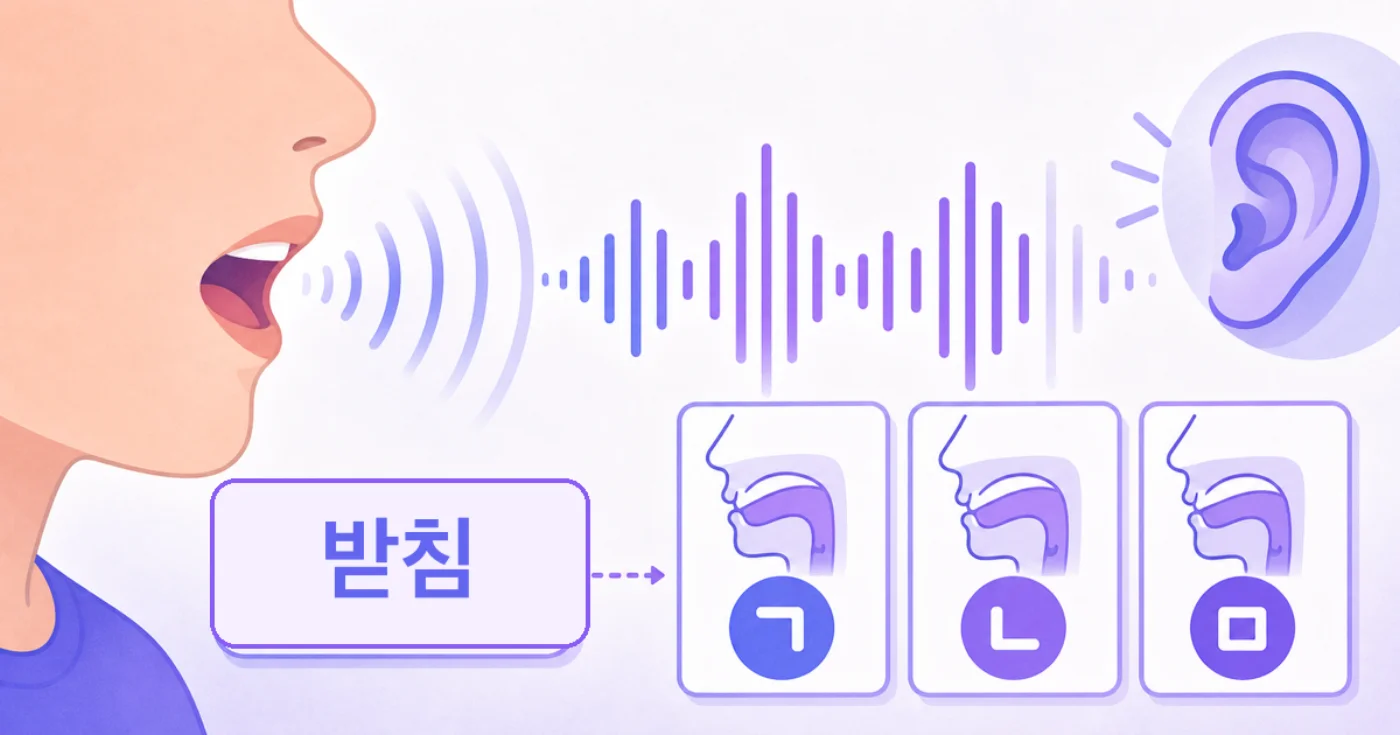
Why Pronunciation Matters More Than You Think
Korean has several sounds that simply do not exist in English. Unlike vocabulary or grammar, pronunciation mistakes can change meaning entirely. Say 배 (bae) with the wrong vowel and you might mean "stomach" when you meant "pear" — or vice versa. The good news is that Korean pronunciation is extremely consistent: once you master the sounds, there are almost no exceptions. Every character always represents the same sound.
This guide focuses on the 10 specific pronunciation challenges that trip up English speakers the most. For each one you will find a clear phonetic explanation, minimal pairs to train your ear, and practical tips you can apply immediately.
1. ㅓ vs ㅗ — The Two "O" Sounds
English has one "o" sound. Korean has two, and confusing them changes the word. ㅗ (o) is a closed, rounded vowel — purse your lips into a small circle, like the "o" in "go." ㅓ (eo) is an open, unrounded vowel — drop your jaw, relax your lips, and say something between the "u" in "bus" and the "aw" in "saw" (British English). The key difference is lip shape: ㅗ = lips rounded, ㅓ = lips relaxed and open.
| Vowel | Lip Shape | Jaw Position | Closest English Sound |
|---|---|---|---|
| ㅗ (o) | Rounded, small circle | Medium height | "o" in "go" (without the glide to "oo") |
| ㅓ (eo) | Relaxed, unrounded | Dropped open | "u" in "cup" or "aw" in "law" |
Quick test: say "go" and freeze your lips at the "o" — that is ㅗ. Now say "cup" and freeze at the "u" — that is close to ㅓ. Practice switching back and forth in front of a mirror until the lip shapes become automatic.
2. ㅡ (eu) — The Vowel With No English Equivalent
ㅡ is a high, central, unrounded vowel. English simply does not have it. To produce it, spread your lips wide (as if smiling) and say "oo" without rounding your lips at all. Your tongue should be high in your mouth, roughly in the center. It is not the "oo" in "food" (that is ㅜ, with rounded lips) and not the "uh" in "fun" (that is too low). Think of the sound you might make when someone punches you lightly in the stomach — a short, tight, neutral grunt.
A reliable trick: say the English word "roses." The unstressed second vowel (ros-EZ) is close to ㅡ. Or say "uh" while spreading your lips into a smile — the resulting sound is very close.
3. ㄱ / ㅋ / ㄲ — The Three "K/G" Sounds
English distinguishes only two sounds in this position: voiced "g" (as in "go") and voiceless "k" (as in "kite"). Korean has three, and the distinction is based on aspiration and tension rather than voicing. ㄱ (plain) is lax with little air, falling between English "g" and "k." ㅋ (aspirated) has a strong burst of air, like the "k" in "kite." ㄲ (tense) is produced with a tight, stiff throat and no air at all — similar to the "g" in "sky" where the "s" blocks the puff of air.
| Character | Type | Airflow | Throat Tension | English Approximation |
|---|---|---|---|---|
| ㄱ | Plain (lax) | Minimal | Relaxed | Between "g" and "k" — like "g" in "ago" |
| ㅋ | Aspirated | Strong puff | Relaxed | "k" in "kite" — hold hand in front of mouth and feel the air |
| ㄲ | Tense (fortis) | None | Tight, stiff | "k" in "sky" — no air release, sharp and clipped |
The "tissue paper test" works well here: hold a tissue in front of your mouth. For ㅋ the tissue should flutter. For ㄲ it should not move at all. For ㄱ it should barely move.
4. ㄷ / ㅌ / ㄸ — The Three "D/T" Sounds
The same three-way distinction applies to the alveolar (tongue-tip) consonants. ㄷ (plain) is between English "d" and "t." ㅌ (aspirated) is a strong breathy "t." ㄸ (tense) is a tight, sharp "t" with no air. The tongue position is the same for all three — what changes is airflow and muscle tension in the larynx.
| Character | Type | Airflow | English Approximation |
|---|---|---|---|
| ㄷ | Plain | Minimal | Between "d" and "t" — like "d" in "adapt" |
| ㅌ | Aspirated | Strong puff | "t" in "top" |
| ㄸ | Tense | None | "t" in "stop" — clipped, no air |
5. ㅂ / ㅍ / ㅃ — The Three "B/P" Sounds
And once more for the bilabial (lip) consonants. ㅂ (plain) is between "b" and "p." ㅍ (aspirated) is a puffy "p." ㅃ (tense) is a hard, clipped "p" with absolutely no air. If you master one of these three-way sets, the pattern transfers directly to the others.
| Character | Type | Airflow | English Approximation |
|---|---|---|---|
| ㅂ | Plain | Minimal | Between "b" and "p" — like "b" in "about" |
| ㅍ | Aspirated | Strong puff | "p" in "pie" |
| ㅃ | Tense | None | "p" in "spy" — lips press hard, no air |
The three-way consonant distinction (plain / aspirated / tense) is the single biggest pronunciation hurdle for English speakers. English only distinguishes voiced vs voiceless (b vs p, d vs t, g vs k). Korean ignores voicing and instead uses airflow and throat tension. Practice all three sets together: 가-카-까, 다-타-따, 바-파-빠.
6. ㄹ — Neither "R" Nor "L"
ㄹ is perhaps the most misunderstood Korean consonant. It is not the English "r" (which curls the tongue back) and not the English "l" (which presses the tongue firmly against the ridge). Its actual pronunciation depends on position:
- At the beginning of a syllable (before a vowel): a single quick flap of the tongue against the ridge behind the teeth — like the quick "d" in the American English pronunciation of "butter" or "ladder." This is called an alveolar flap or tap.
- At the end of a syllable (받침 position): a lateral "l" sound where the tongue touches the ridge and stays there, with air flowing around the sides. Very similar to a light, gentle English "l."
- Between two vowels: a flap, the same as the initial position.
- When doubled (ㄹㄹ): a longer, sustained lateral "l" — hold the tongue against the ridge. Example: 빨리 (ppalli, quickly).
Practice the flap by saying the American English word "butter" quickly. The sound your tongue makes on the double-t is almost exactly the Korean ㄹ flap. Never curl your tongue back like an English "r" — Korean ㄹ always touches the ridge.
7. ㅢ (ui) — The Tricky Complex Vowel
ㅢ is a combination of ㅡ + ㅣ, and its pronunciation changes depending on where it appears in a word. This is one of the few genuinely irregular sounds in Korean:
- Word-initial (의): Pronounced as written — start with ㅡ and glide smoothly into ㅣ. Example: 의사 (uisa, doctor).
- Non-initial syllable: Often collapses to just ㅣ in casual speech. Example: 회의 (hoeui → hoei, meeting).
- As the possessive particle 의: Almost always pronounced 에 (e) in natural speech. Example: 나의 (naui → nae, my).
8. 받침 (batchim) — Final Consonant Sound Changes
In Korean, a consonant at the bottom of a syllable block is called 받침 (batchim). While there are 27 possible final consonant combinations in writing, they are all pronounced as just one of 7 representative sounds. This is called neutralization, and it is one of the most important pronunciation rules in Korean.
| Pronounced As | Written Forms |
|---|---|
| ㄱ [k] | ㄱ, ㅋ, ㄲ, ㄳ, ㄺ |
| ㄴ [n] | ㄴ, ㄵ, ㄶ |
| ㄷ [t] | ㄷ, ㅌ, ㅅ, ㅆ, ㅈ, ㅊ, ㅎ |
| ㄹ [l] | ㄹ, ㄼ, ㄽ, ㄾ, ㅀ |
| ㅁ [m] | ㅁ, ㄻ |
| ㅂ [p] | ㅂ, ㅍ, ㄿ, ㅄ |
| ㅇ [ng] | ㅇ |
When a 받침 consonant stands alone (not followed by a vowel), your tongue or lips move into position but never fully release. Think of saying "cup" but freezing your lips at the "p" without the burst of air. This "unreleased" stop is characteristic of Korean pronunciation.
9. 연음 (yeonum) — Linking and Liaison Rules
When a syllable ends with a 받침 consonant and the next syllable begins with the silent placeholder ㅇ, the final consonant "jumps" to become the initial consonant of the next syllable. This is called 연음 (liaison), and it is one of the most important rules for natural-sounding Korean. It is the reason that written Korean and spoken Korean can look very different.
Other Key Sound Change Rules
Beyond basic liaison, Korean has several systematic sound changes that apply at syllable boundaries. These are not exceptions — they are reliable, predictable rules.
Nasalization (비음화)
When a stop consonant (ㄱ, ㄷ, ㅂ) appears before a nasal consonant (ㄴ or ㅁ), the stop assimilates and becomes the corresponding nasal sound: ㄱ→ㅇ, ㄷ→ㄴ, ㅂ→ㅁ.
Aspiration (격음화)
When ㅎ meets a plain consonant (ㄱ, ㄷ, ㅂ, ㅈ) — in either order — they merge into the aspirated version (ㅋ, ㅌ, ㅍ, ㅊ).
Palatalization (구개음화)
When ㄷ or ㅌ appear as 받침 before the vowel 이, they shift to ㅈ or ㅊ respectively. This only happens across a morpheme boundary (e.g., when a suffix starting with 이 is added).
10. Double 받침 — Consonant Clusters at Syllable Ends
Some syllables end with two consonants stacked together (double 받침). When the syllable is at the end of a word or before another consonant, only one of the two is pronounced. Which one survives follows specific rules:
| Cluster | Pronounced Consonant | Example | Pronunciation |
|---|---|---|---|
| ㄳ | ㄱ | 몫 (share/portion) | [목] |
| ㄵ | ㄴ | 앉다 (to sit) | [안따] |
| ㄺ | ㄱ | 닭 (chicken) | [닥] |
| ㄻ | ㅁ | 삶 (life) | [삼] |
| ㄼ | ㄹ | 여덟 (eight) | [여덜] |
| ㄽ | ㄹ | 외곬 (one way) | [외골] |
| ㄾ | ㄹ | 핥다 (to lick) | [할따] |
| ㄿ | ㄹ | 읊다 (to recite) | [을따] |
| ㅀ | ㄹ | 잃다 (to lose) | [일타] |
| ㅄ | ㅂ | 없다 (to not have) | [업따] |
| ㄶ | ㄴ | 많다 (to be many) | [만타] |
However, when a double 받침 is followed by a syllable starting with a vowel (ㅇ), both consonants are pronounced: the first stays as the 받침 and the second links (연음) to the next syllable. For example, 닭이 (chicken + subject marker) is pronounced [달기], not [다기].
A general rule of thumb: in most double 받침 clusters, the left consonant is the one that survives when the next syllable starts with a consonant. The main exceptions are ㄺ (where ㄱ on the right wins) and ㄻ (where ㅁ on the right wins). When the next syllable starts with a vowel, both consonants are always pronounced.
Putting It All Together: Practice Strategy
Korean pronunciation is highly systematic. Unlike English, where spelling and pronunciation are often unrelated, Korean sounds follow dependable rules. The challenges above can all be overcome with focused practice. Here is a practical approach:
- Start with the vowels: master ㅓ vs ㅗ and ㅡ first. These distinctions underpin countless words.
- Tackle the three-way consonants as a set: practice 가-카-까, 다-타-따, 바-파-빠 as triplets, not individually.
- Record yourself and compare: use your phone to record yourself saying minimal pairs, then compare to native audio.
- Practice ㄹ in different positions: say 라, 알, 어리, 빨리 and notice how the same character changes.
- Read aloud daily: even 5 minutes of reading Korean text out loud builds muscle memory for sound changes.
- Learn sound change rules one at a time: start with 연음 (liaison), then nasalization, then aspiration. Apply them consciously when reading.
- Shadow native speakers: listen to a Korean sentence, then immediately repeat it mimicking the rhythm, intonation, and connected speech.
Pronunciation is a physical skill, not just a mental one. Your mouth, tongue, and throat need to build new muscle memory. Short daily practice (5-10 minutes) is far more effective than long occasional sessions. Focus on one sound per week and it will become natural within a few months.
Quick Reference: Sound Change Cheat Sheet
| Rule | When It Applies | What Happens | Example |
|---|---|---|---|
| Liaison (연음) | 받침 + ㅇ initial | Consonant moves to next syllable | 먹어요 → [머거요] |
| Neutralization | 받침 at word end / before consonant | Reduces to 7 base sounds | 옷 → [옫], 부엌 → [부억] |
| Nasalization (비음화) | Stop (ㄱ,ㄷ,ㅂ) + nasal (ㄴ,ㅁ) | Stop becomes nasal | 한국말 → [한궁말] |
| Aspiration (격음화) | ㅎ + plain stop (or reverse) | Merges into aspirated consonant | 좋다 → [조타] |
| Palatalization (구개음화) | ㄷ/ㅌ + 이 | Becomes ㅈ/ㅊ + 이 | 같이 → [가치] |
| Tensification (경음화) | Stop 받침 + plain consonant | Following consonant becomes tense | 학교 → [학꾜] |
These rules may seem overwhelming at first, but remember: native Korean children internalize them all by the time they start school, just through exposure. As an adult learner, you have the advantage of understanding the system explicitly. With consistent practice and attentive listening, these sound changes will become second nature.
Train Your Ear
Pronunciation lives in the ear before it lives in the mouth. Tap each word below to hear a native speaker, then repeat it out loud. Pay attention to the difference between plain and aspirated sounds -- this is the single hardest contrast for most learners.
Quick Check: Korean Pronunciation
1. In 먹어요, why is it pronounced [머거요]?
2. Korean stops come in three forms. Which set is correct?
3. What happens to 한국말 when spoken (한국말 → [한궁말])?
Keep practicing with native-speaker audio
Every word is recorded by a native Korean speaker — tap to listen, free and without signing up.
Start Learning Korean Today
Master Hangul in 7 days with interactive lessons, AI conversation practice, and spaced repetition. 100% free to start.
Get Started FreeRelated Articles
Complete Guide to Korean Consonants and Vowels (자음과 모음)
Learn all 40 Korean Hangul characters: 14 basic consonants, 5 double consonants, 10 basic vowels, and 11 compound vowels with pronunciation, examples, and memory tips.
What Is Hangul? The Complete Guide to the Korean Alphabet
Discover Hangul, the Korean alphabet created by King Sejong in 1443. Learn why it's considered one of the most scientific writing systems ever invented.
10 Common Mistakes English Speakers Make When Learning Korean
Avoid these 10 common mistakes English speakers make when learning Korean. From pronunciation pitfalls to grammar mix-ups, learn how to fix them.