Complete Guide to Korean Consonants and Vowels (자음과 모음)
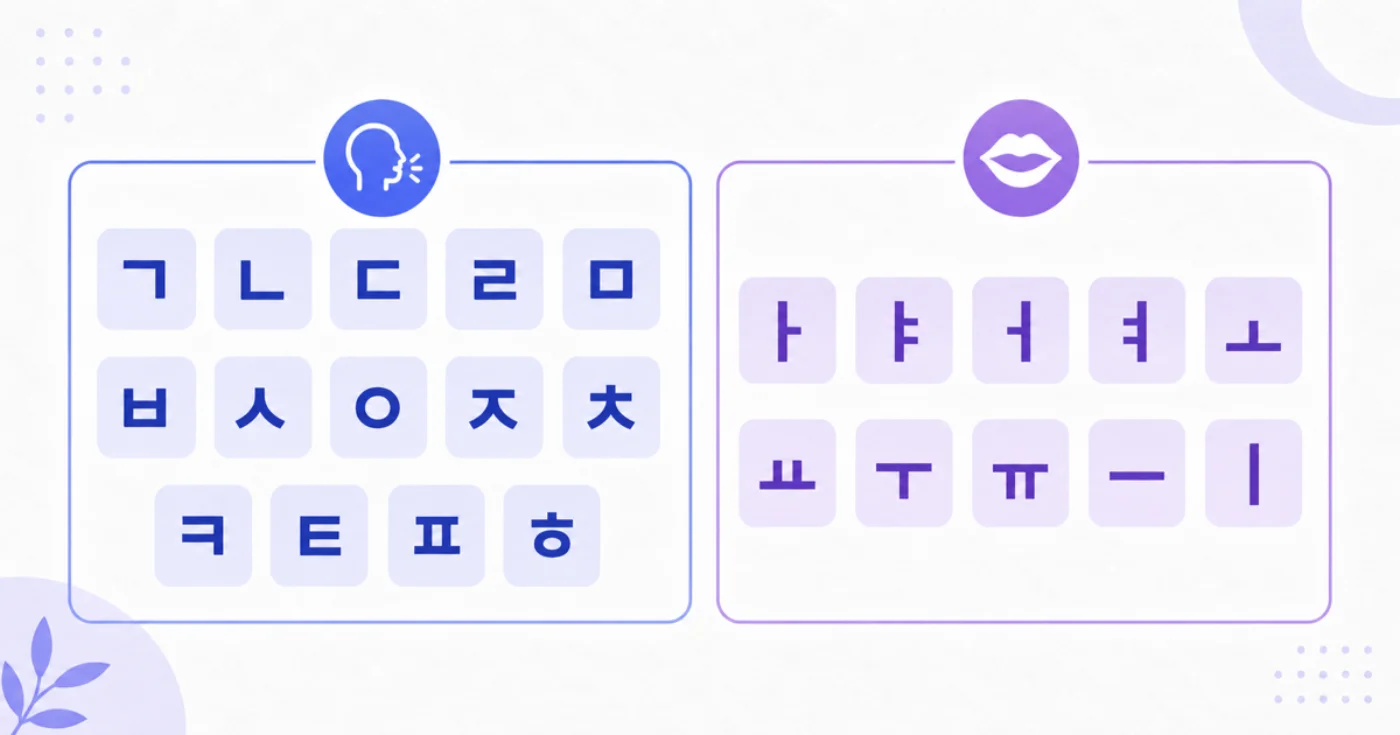
The Building Blocks of Korean
Korean writing is built from individual characters called 자모 (jamo). There are 40 characters in total: 19 consonants (14 basic + 5 double) and 21 vowels (10 basic + 11 compound). These combine into syllable blocks to form every Korean word. Let's master them all.
You don't need to memorize all 40 at once! Start with the 14 basic consonants and 10 basic vowels. The doubles and compounds are just combinations of these basics.
14 Basic Consonants (기본 자음)
Korean consonants are organized by how they're pronounced. Characters that look similar also sound similar — King Sejong designed it this way intentionally!
Velar Sounds (목구멍소리) — Made at the back of the throat
Alveolar Sounds (잇소리) — Made with the tongue behind the teeth
Bilabial Sounds (입술소리) — Made with both lips
Sibilant Sounds (치조소리) — Hissing sounds
Glottal Sounds (후두소리)
5 Double Consonants (쌍자음)
Double consonants are tensed versions of 5 basic consonants. They're written as two copies side by side and pronounced with more tension in the throat — no air puff, just a sharp, strong sound.
| Double | Base | Sound | Example |
|---|---|---|---|
| ㄲ | ㄱ+ㄱ | Like "g" in "ski" (no air) | 까지 (kkaji) = until |
| ㄸ | ㄷ+ㄷ | Like "t" in "steak" (no air) | 때 (ttae) = time/when |
| ㅃ | ㅂ+ㅂ | Like "p" in "spy" (no air) | 빨리 (ppalli) = quickly |
| ㅆ | ㅅ+ㅅ | Stronger "ss" sound | 쓰다 (sseuda) = to write |
| ㅉ | ㅈ+ㅈ | Stronger "jj" sound | 짜다 (jjada) = salty |
English doesn't have tensed consonants, so these are tricky! Think of the difference between the "p" in "spy" (tensed, no air) vs "pie" (aspirated, with air). Korean has three levels: plain (ㄱ), aspirated (ㅋ), and tensed (ㄲ).
10 Basic Vowels (기본 모음)
Korean vowels are elegantly simple — they're all built from three elements: a vertical line (ㅣ), a horizontal line (ㅡ), and a dot (which evolved into a short stroke). These represent human (standing), earth (flat), and heaven (the dot/sun).
Vertical Vowels (세로 모음)
Horizontal Vowels (가로 모음)
11 Compound Vowels (복합 모음)
Compound vowels are combinations of basic vowels. Once you know the basics, these are intuitive:
| Vowel | Combination | Sound | Example |
|---|---|---|---|
| ㅐ | ㅏ + ㅣ | Like "e" in "bed" | 개 (gae) = dog |
| ㅒ | ㅑ + ㅣ | Like "ye" in "yes" | 얘기 (yaegi) = talk |
| ㅔ | ㅓ + ㅣ | Like "e" in "bed" (same as ㅐ in modern Korean) | 세계 (segye) = world |
| ㅖ | ㅕ + ㅣ | Like "ye" in "yes" | 예 (ye) = yes |
| ㅘ | ㅗ + ㅏ | "wa" as in "want" | 과일 (gwail) = fruit |
| ㅙ | ㅗ + ㅐ | "wae" — like "we" in "wet" | 왜 (wae) = why |
| ㅚ | ㅗ + ㅣ | "we" — like "we" in "wet" | 외국 (oeguk) = foreign country |
| ㅝ | ㅜ + ㅓ | "wo" — like "won" | 원 (won) = Korean currency |
| ㅞ | ㅜ + ㅔ | "we" — like "wet" | 웨이터 (weiteo) = waiter |
| ㅟ | ㅜ + ㅣ | "wi" — like "we" | 위 (wi) = top/above |
| ㅢ | ㅡ + ㅣ | "ui" — say ㅡ then slide to ㅣ | 의사 (uisa) = doctor |
In modern Korean, ㅐ and ㅔ sound nearly identical. Even native speakers sometimes mix them up in writing! Don't stress about the difference — context always makes the meaning clear.
How Characters Form Syllable Blocks
Korean characters don't sit in a line like English letters. Instead, they stack into square syllable blocks. Every block must start with a consonant (use ㅇ as a silent placeholder for vowel-initial syllables).
Your Learning Path
Here's a suggested order for mastering all 40 characters:
- Week 1: 14 basic consonants — focus on recognition and stroke order
- Week 1-2: 10 basic vowels — practice combining with consonants
- Week 2: Start reading simple syllable blocks (가, 나, 다, ...)
- Week 3: 5 double consonants — learn the tensed pronunciation
- Week 3-4: 11 compound vowels — these come naturally if you know the basics
- Week 4+: Full reading practice with real Korean words
With consistent daily practice, most learners can recognize all 40 characters within 2-4 weeks. HangeulMate's Level 0 curriculum is designed around exactly this progression, with visual mnemonics, audio pronunciation, quizzes, and writing practice for every character.
Consonants & Vowels — Quick Check
1. How many basic consonants does Hangul have?
2. Which of these is a vowel, not a consonant?
Hear the Consonants and Vowels
Letters become real once you hear them. Tap each consonant sound and vowel below to hear a native speaker. Repeat each one aloud -- consonants carry the basic sound, and vowels give every syllable its voice.
Keep practicing with native-speaker audio
Every word is recorded by a native Korean speaker — tap to listen, free and without signing up.
Start Learning Korean Today
Master Hangul in 7 days with interactive lessons, AI conversation practice, and spaced repetition. 100% free to start.
Get Started FreeRelated Articles
What Is Hangul? The Complete Guide to the Korean Alphabet
Discover Hangul, the Korean alphabet created by King Sejong in 1443. Learn why it's considered one of the most scientific writing systems ever invented.
How to Write Korean: The Complete Hangul Stroke Order Guide
Master the correct stroke order for all 24 Korean Hangul characters. Learn the rules, see visual examples, and practice writing consonants and vowels the right way.
How to Read Korean in 30 Minutes: A Beginner's Quick Start
Learn to read Korean in just 30 minutes with this step-by-step guide. Master basic consonants, vowels, and syllable blocks with pronunciation tips.