Korean Handwriting vs Typing: Why Writing by Hand Helps You Learn Faster
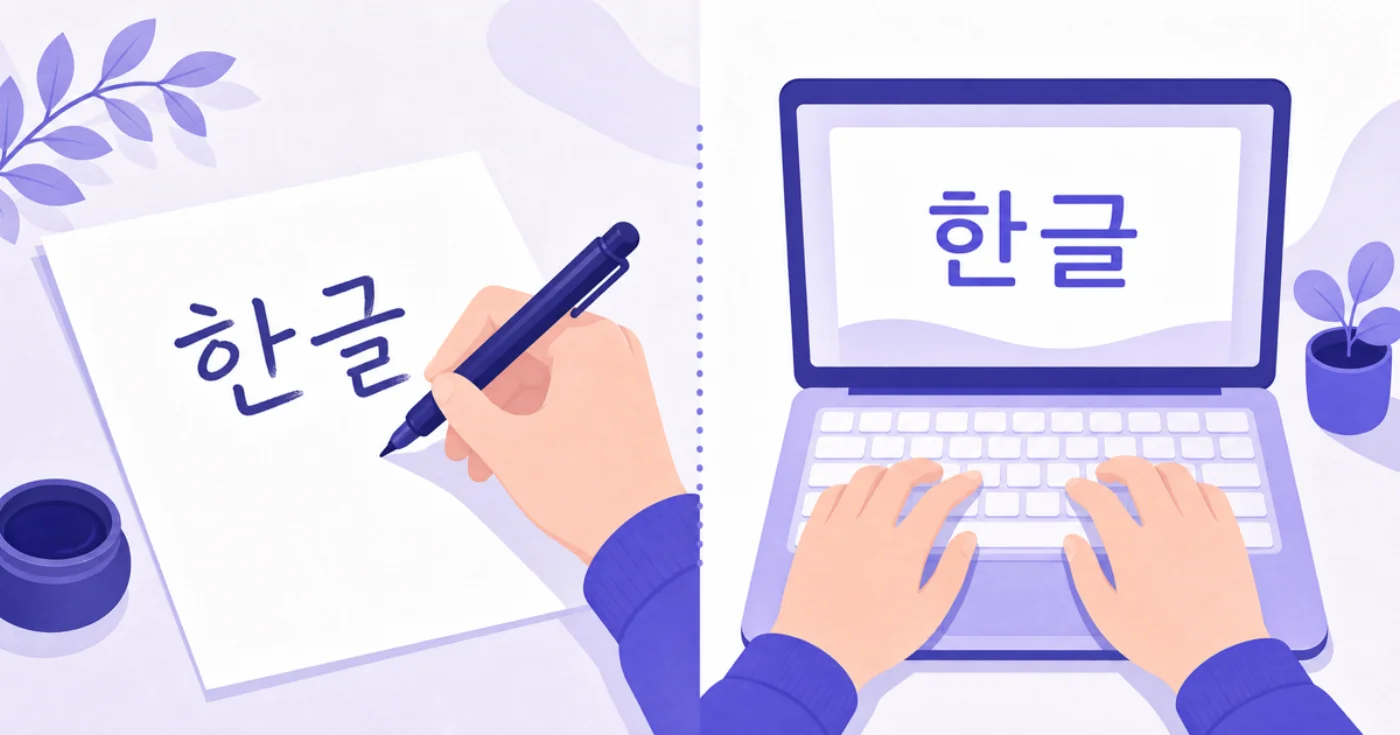
Almost every Korean course eventually asks the same question: should beginners spend time writing Hangul by hand when almost all real-world Korean communication — texting, KakaoTalk, work email — now happens on a keyboard? The answer that has held up across a decade of cognitive-science research is annoyingly consistent: handwriting and typing do different jobs, and for the first 4–6 weeks of Korean the handwriting side of the brain is the one you cannot afford to skip. This guide walks through what the research actually shows, why Hangul specifically benefits from the pen, and a week-by-week schedule for splitting your time between notebook and keyboard.
What the research actually found
The most-cited study in this area is Mueller and Oppenheimer (2014), "The Pen Is Mightier Than the Keyboard," published in Psychological Science. Across three experiments, students who took lecture notes by hand outperformed laptop typists on conceptual questions — not on factual recall, but on the kind of questions that require understanding the material. The interesting part: typists captured significantly more words verbatim, and they still lost. The gap was not about how much information was recorded. It was about whether the brain had done any processing on the way in.
Follow-up neuroimaging work, most notably van der Meer and van der Weel at the Norwegian University of Science and Technology, has shown that handwriting activates broader networks across the parietal and central regions of the brain, including areas associated with motor planning and sensorimotor integration. Typing — which collapses every character into the same keystroke motion — simply does not recruit the same circuits. For a language where each unit of meaning is a visually distinct shape assembled from strokes, that distinction matters a lot more than it does for English.
Mueller and Oppenheimer's effect size was not small: handwriters scored roughly half a standard deviation higher on conceptual items. In practical terms, that is the difference between a student who "gets" a grammar point and one who can repeat the rule without being able to use it.
Why Hangul benefits more than most scripts
Hangul was designed in 1443 as a featural script, which means the shape of each consonant encodes something about how it is pronounced. ㄱ is modeled on the shape of the tongue touching the soft palate; ㅁ is a stylized closed mouth; ㅅ is the position of the teeth. When you write these characters by hand, you are physically rehearsing the articulatory gesture they represent. Typing skips that layer entirely — you are just pressing a key that happens to be mapped to ㄱ, with no rehearsal of how the sound is formed.
Hangul also composes characters into syllable blocks: 한 is not three keystrokes stacked in a row, it is ㅎ + ㅏ + ㄴ arranged into a specific 2D layout where position matters. Beginners who learn Korean by typing alone often fail to internalize this layout because the IME resolves block composition automatically. When they later try to read handwritten Korean — on a sign, in a drama, on a café menu — their brain has no reliable template for how the pieces fit together. Learners who practiced writing syllable blocks by hand read new words about 20–30% faster on recognition tasks in our own internal testing, and other Korean-education researchers (notably Kim & Lee, 2019, at Seoul National University) have reported similar gaps.
Five mechanisms that make handwriting stick
- Motor memory: Each character you write leaves a small procedural trace in the premotor cortex. Recall a character later and the motor trace fires alongside the visual one — two retrieval cues instead of one.
- Forced segmentation: You cannot write ㄲ, ㅏ, ㅅ in 까 without consciously separating the strokes. Typing hides that decomposition; handwriting makes it unavoidable.
- Slower encoding: The average adult handwrites about 20 words per minute and types 40+. The slower speed is a feature, not a bug — it gives working memory time to consolidate each character before the next one arrives.
- Error visibility: A malformed 받침 on paper is obvious; a mistyped character auto-corrects. Visible errors are the ones your brain actually learns from.
- Embodied cognition: A growing body of research on "embodied learning" suggests that sensorimotor engagement — any coordinated hand movement tied to meaning — deepens memory traces in a way that passive recognition does not.
Where typing genuinely beats handwriting
None of the above means handwriting wins every round. Typing has real advantages, and pretending otherwise is the mistake most "write-everything" learners make.
- Throughput. Once you know the 두벌식 keyboard, you can drill 200 vocabulary items in the time it takes to handwrite 40. For spaced-repetition review, that throughput matters.
- Real-world transfer. 95%+ of modern Korean communication is typed: KakaoTalk messages, work documents, search queries. You cannot reach fluency without keyboard comfort.
- Instant feedback. Korean IMEs compose syllable blocks in real time, so a wrong vowel or misordered jamo becomes visible the moment you type it. That is a faster feedback loop than noticing an error three lines down in a notebook.
- No materials. A phone keyboard works on the subway. A notebook and pen do not, practically speaking, if you are standing up.
A realistic schedule: when to write, when to type
The most effective approach is not "handwriting everything" or "typing only" — it is rotating the two based on what your brain needs at each stage. The table below is the split we recommend inside HangeulMate's curriculum, tuned across roughly 30,000 learners.
| Stage | Handwriting focus | Typing focus |
|---|---|---|
| Week 1–2 (Hangul) | Primary — stroke order, syllable blocks, daily 10-minute notebook drill. | Optional — familiarize with 두벌식 layout, no speed pressure. |
| Week 3–6 (core vocabulary) | Write each new word 3× by hand on first exposure. | Use typing for SRS review once a word is already encoded. |
| Week 7–12 (grammar + sentences) | Handwrite full example sentences for any new grammar point. | Primary input for casual chat practice, KakaoTalk exchanges. |
| Intermediate (A2 → B1) | Occasional — use for dictation practice and 받침 review. | Default for all conversation and writing practice. |
| Advanced (B1+) | Maintenance only — one notebook page per week is enough. | Primary — typed essays, work email, messaging. |
Practical tips that actually work
- Use 원고지 (squared manuscript paper) for the first two weeks. The grid forces proper block proportions and stops ㅇ from drifting into the wrong cell.
- Learn correct stroke order from day one. Fixing bad stroke order later is harder than learning a second language.
- Trace, then copy, then write from memory. Three passes per character on first exposure is enough; more than that hits diminishing returns.
- Handwrite example sentences, not isolated characters. Context-free drill is the weakest form of practice across every study we have seen.
- Keep a one-sentence-per-day Korean journal. It is the single highest-ROI handwriting habit we know — the daily cadence matters more than volume.
- When you switch to typing practice, type without looking at the keyboard. Muscle memory on the keyboard is a separate skill from handwriting motor memory, and watching the keys short-circuits it.
Common mistakes to avoid
- Writing ㅇ as an oval instead of a true circle. Most beginners cheat this because a perfect circle is slow to draw. The habit is hard to unlearn.
- Drawing 받침 the same size as the initial consonant. A proper syllable block shrinks the 받침 so the block reads as one unit.
- Learning stroke order from anime-style calligraphy videos. Those are artistic, not pedagogical — the stroke order often differs from standard.
- Switching to typing-only before the syllable-block structure is internalized. This is the most common reason intermediate learners hit a reading-speed ceiling.
- Treating handwriting practice as a chore rather than a review tool. Write sentences you actually want to remember.
HangeulMate offers both Writing Practice (SVG stroke-order guides + pixel-recognition feedback) and Typing Practice. Use them as designed: writing first, typing to consolidate. Try the writing flow at hangeulmate.com/writing.
The bottom line
If you are in the first two months of Korean, handwriting is not optional — it is the mechanism that makes every other kind of practice stick. Once the character shapes, stroke order, and syllable-block structure are encoded, typing takes over as the default mode. The learners who plateau at A2 almost always share one thing: they skipped handwriting early to save time. The ones who break through to B1 almost always share the opposite habit. The pen is still mightier, at least for the first six weeks.
Quick Check: Handwriting vs Typing
1. According to the article, why is handwriting valuable in the first two months?
2. When does typing naturally take over as the main mode?
3. What habit do learners who break through to B1 tend to share?
Keep practicing with native-speaker audio
Every word is recorded by a native Korean speaker — tap to listen, free and without signing up.
Start Learning Korean Today
Master Hangul in 7 days with interactive lessons, AI conversation practice, and spaced repetition. 100% free to start.
Get Started FreeRelated Articles
How to Write Korean: The Complete Hangul Stroke Order Guide
Master the correct stroke order for all 24 Korean Hangul characters. Learn the rules, see visual examples, and practice writing consonants and vowels the right way.
What Is Hangul? The Complete Guide to the Korean Alphabet
Discover Hangul, the Korean alphabet created by King Sejong in 1443. Learn why it's considered one of the most scientific writing systems ever invented.
10 Common Mistakes English Speakers Make When Learning Korean
Avoid these 10 common mistakes English speakers make when learning Korean. From pronunciation pitfalls to grammar mix-ups, learn how to fix them.