Korean Sentence Structure: Understanding SOV Word Order
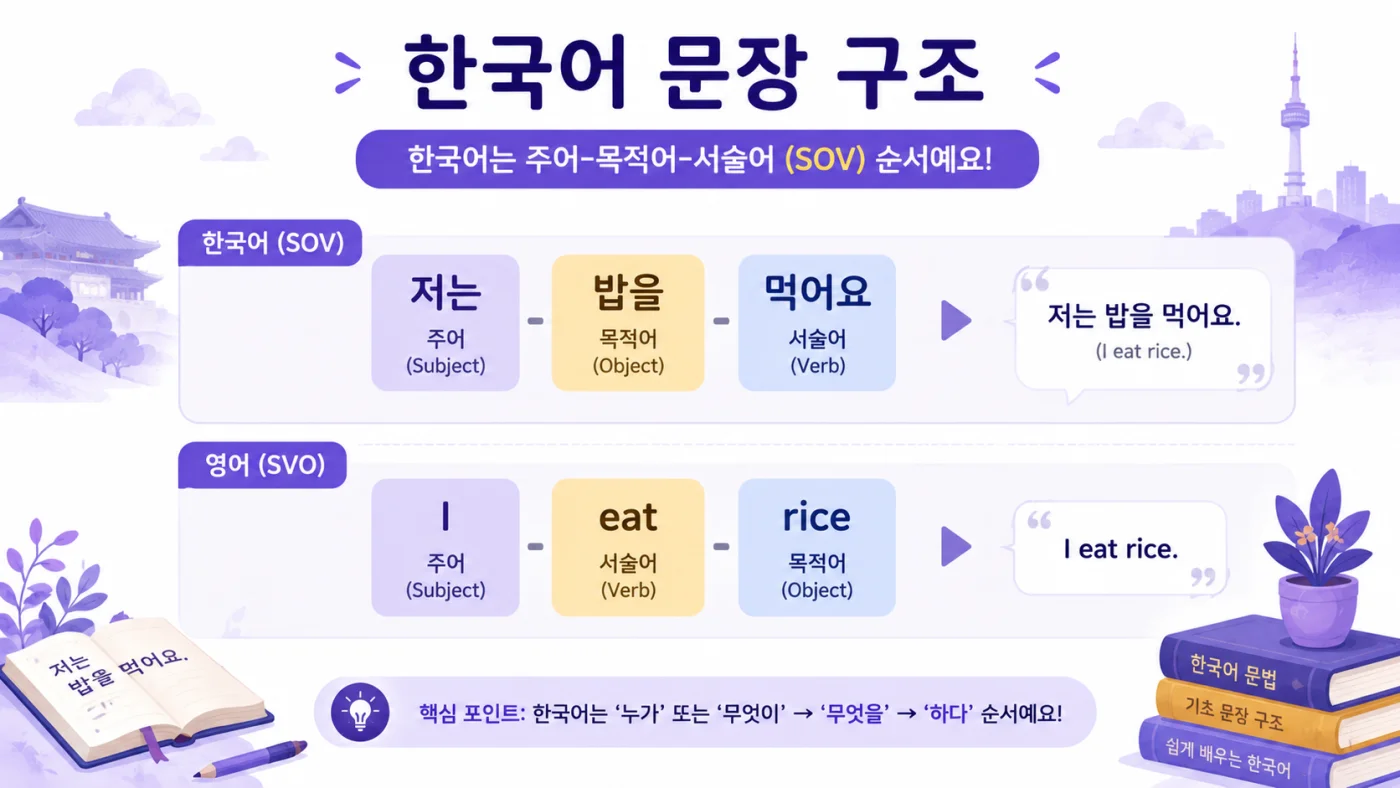
The Biggest Difference: SOV vs. SVO
English follows a Subject-Verb-Object (SVO) word order: "I eat rice." Korean flips this to Subject-Object-Verb (SOV): "I rice eat." This single difference is the key to understanding how Korean sentences work. The verb always comes at the end of a Korean sentence -- always. Once you internalize this rule, building Korean sentences becomes dramatically easier.
Think of Korean sentences as having a simple formula: [Who/What] + [Details] + [Action]. No matter how long or complex a sentence gets, the verb always sits at the very end.
How Particles Hold the Sentence Together
In English, word order tells us who is doing what: "The dog chased the cat" means something very different from "The cat chased the dog." Korean uses small words called particles (조사, josa) attached to nouns to mark their role instead. Because particles carry that information, Korean word order is more flexible than English -- as long as the verb stays at the end.
The four particles you will meet first are the topic marker 은/는, the subject marker 이/가, the object marker 을/를, and the location markers 에 / 에서. The quick reference below is enough to start building sentences. For a deeper dive — when to choose 은/는 vs 이/가, how 에 and 에서 really differ, and the common mistakes learners make — see our full guide to Korean particles explained.
The one distinction worth memorizing early: 은/는 = "Speaking of X..." (known / general info), while 이/가 = "X is the one that..." (new / specific info). "저는 학생이에요" = "As for me, I'm a student." "제가 학생이에요" = "I'm the one who's a student." The full particles guide walks through every case with examples.
Particle Quick Reference
| Particle | Function | After Consonant | After Vowel | Example |
|---|---|---|---|---|
| Topic | What the sentence is about | 은 | 는 | 저는 (as for me) |
| Subject | Who does the action | 이 | 가 | 비가 (rain does) |
| Object | What receives the action | 을 | 를 | 밥을 (rice, as object) |
| Destination/Location | To / at (static) | 에 | 에 | 학교에 (to school) |
| Action location/From | At (doing) / from | 에서 | 에서 | 집에서 (at home, doing) |
Making Negative Sentences
Korean has two main ways to make negative sentences. The simplest method places 안 (an) directly before the verb. The more formal method uses the verb stem + 지 않다 (ji anta) construction. Both are commonly used, but 안 is more casual and common in everyday speech.
Use 안 for "don't" (choosing not to) and 못 for "can't" (unable to). "안 먹어요" = "I don't eat (by choice)." "못 먹어요" = "I can't eat (due to circumstances)."
Building Your First Sentences
Now that you understand the SOV structure and basic particles, here are some complete sentences that put everything together. Notice how each one follows the same pattern: subject/topic first, details in the middle, verb at the end.
Key Takeaways
- Korean is SOV: the verb always comes at the end of the sentence
- Particles (은/는, 이/가, 을/를) mark the role of each noun, not word order
- Topic (은/는) sets what the sentence is about; subject (이/가) marks the doer
- Location particle 에 = destination or static location; 에서 = action location or origin
- Negate with 안 (choose not to) or 못 (unable to) before the verb
- Particle choice depends on the final sound: consonant or vowel
Hear the Verb That Ends the Sentence
Because Korean is SOV, the verb is the last thing you say -- and the last thing you hear. Tap these common sentence-final verbs to hear how they sound. In real Korean, everything builds toward this final word.
Quick Check: Korean Sentence Structure
1. What is the basic word order of a Korean sentence?
2. In Korean, what tells you the role of each noun in a sentence?
3. How do you negate a verb by choice (e.g. "I do not eat")?
Practice these words with native-speaker audio
Every word is recorded by a native Korean speaker — tap to listen, free and without signing up.
Start Learning Korean Today
Master Hangul in 7 days with interactive lessons, AI conversation practice, and spaced repetition. 100% free to start.
Get Started FreeRelated Articles
Korean Honorifics Explained: Formal, Polite, and Casual Speech
Understand the Korean honorific system: formal (합쇼체), polite (해요체), and casual (해체) speech levels. Learn when to use each with real examples.
10 Common Mistakes English Speakers Make When Learning Korean
Avoid these 10 common mistakes English speakers make when learning Korean. From pronunciation pitfalls to grammar mix-ups, learn how to fix them.
Korean Particles Explained: The Essential Guide to 은/는, 이/가, 을/를
Master the most important Korean particles. Learn when to use topic markers, subject markers, and object markers with clear examples and common mistakes to avoid.