Korean Honorifics Explained: Formal, Polite, and Casual Speech
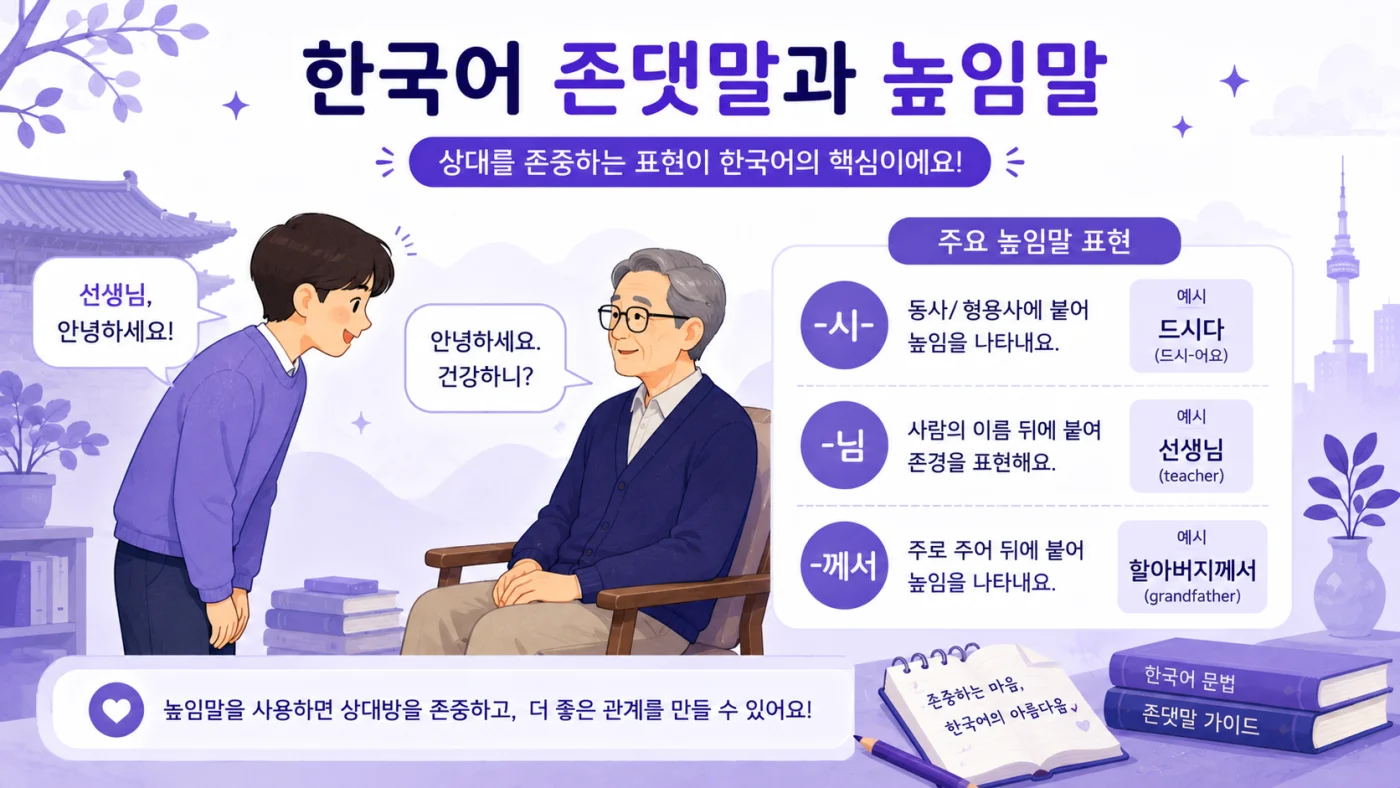
One of the first things you will notice about Korean is that people speak differently depending on who they are talking to. A student speaking to a professor sounds completely different from two friends chatting over coffee. This is because Korean has a built-in system of speech levels called 존댓말 (jondaenmal, honorific speech) and 반말 (banmal, casual speech). Understanding these levels is not optional — using the wrong one can cause real social awkwardness or even offense.
Why Honorifics Matter in Korean
Korean society places a high value on social hierarchy, age, and relationships. The language reflects this through verb endings, vocabulary choices, and even sentence structure. When you meet someone in Korea, one of the first things people figure out is relative age — because it determines how you speak to each other. While English speakers might say "please" or "sir" to be polite, Korean encodes politeness directly into verb conjugations.
There are technically seven speech levels in Korean, but in modern daily life, three are used regularly. These are formal (합쇼체, hapshoche), polite (해요체, haeyoche), and casual (해체, haeche). Mastering these three will cover virtually every situation you encounter.
The Three Main Speech Levels
1. Formal Speech (합쇼체 / Hapshoche)
Formal speech is the most respectful level. You will hear it in news broadcasts, business presentations, military settings, and when addressing someone of significantly higher status. The verb endings are -(스)ㅂ니다 (-(seu)bnida) for statements and -(스)ㅂ니까 (-(seu)bnikka) for questions.
In formal speech, use 저 (jeo) for "I" instead of 나 (na). This humble form of "I" is a key part of showing respect.
2. Polite Speech (해요체 / Haeyoche)
Polite speech is the most versatile and commonly used level. It is appropriate for everyday conversations with people you are not close to — coworkers, shopkeepers, acquaintances, and anyone you have just met. The verb ending is -아/어요 (-a/eoyo). This is the speech level most Korean textbooks teach first, and for good reason: it is safe to use in almost any situation.
3. Casual Speech (해체 / Haeche)
Casual speech, also called 반말 (banmal), is used between close friends of similar age, with younger siblings, children, or people you are very familiar with. The verb endings drop the 요 (yo) from polite speech. Using casual speech with someone older or unfamiliar is considered rude — even if you do not intend disrespect.
Side-by-Side Comparison
| Meaning | Formal (합쇼체) | Polite (해요체) | Casual (해체) |
|---|---|---|---|
| Thank you | 감사합니다 | 고마워요 | 고마워 |
| Hello | 안녕하십니까 | 안녕하세요 | 안녕 |
| I eat | 먹습니다 | 먹어요 | 먹어 |
| I go | 갑니다 | 가요 | 가 |
| Goodbye (to person leaving) | 안녕히 가십시오 | 안녕히 가세요 | 잘 가 |
| Yes | 예 | 네 | 응 / 어 |
Verb Conjugation Basics
The speech level is determined by the verb ending. Korean verbs have a dictionary form ending in -다 (-da). To conjugate, you remove -다 and add the appropriate ending. Here is how the verb 하다 (hada, "to do") conjugates across the three levels:
| Level | Statement | Question |
|---|---|---|
| Formal | 합니다 (hamnida) | 합니까? (hamnikka?) |
| Polite | 해요 (haeyo) | 해요? (haeyo?) |
| Casual | 해 (hae) | 해? (hae?) |
Notice that in polite speech, statements and questions have the same verb ending — the difference is only in intonation (rising pitch for questions). In formal speech, statements and questions have distinct endings.
When to Use Each Level
- Formal (합쇼체): Job interviews, presentations, news broadcasts, speaking to much older people, military, customer service scripts
- Polite (해요체): Default for daily life — talking to coworkers, shopkeepers, new acquaintances, in-laws, anyone you are unsure about
- Casual (해체): Close friends of similar age, younger siblings, children, romantic partners (after establishing closeness), talking to yourself
When in doubt, use polite speech (해요체). It is never offensive to be too polite. Koreans will tell you when it is okay to switch to casual speech — often by saying "말 놓으세요" (mal nouseyo, "please speak casually").
Honorific Vocabulary
Beyond verb endings, Korean has special honorific vocabulary. When talking about or to someone of higher status, certain words change entirely. These are not just politeness markers — they are separate words that replace the standard ones.
| Standard | Honorific | Meaning |
|---|---|---|
| 먹다 (meokda) | 드시다 (deusida) | to eat |
| 자다 (jada) | 주무시다 (jumusida) | to sleep |
| 있다 (itda) | 계시다 (gyesida) | to be / exist |
| 말하다 (malhada) | 말씀하시다 (malsseum-hasida) | to speak |
| 이름 (ireum) | 성함 (seongham) | name |
| 나이 (nai) | 연세 (yeonse) | age |
| 집 (jip) | 댁 (daek) | house / home |
The Subject Honorific Marker -(으)시-
When the subject of your sentence is someone you want to show respect to, you insert -(으)시- (-(eu)si-) before the verb ending. This works with all three speech levels, though it is most common in polite and formal speech.
Common Mistakes to Avoid
- Using 반말 with someone older: Even if they seem friendly, wait until they invite you to speak casually.
- Mixing levels in one sentence: Stick to one speech level per sentence. Do not combine formal endings with casual pronouns.
- Using 너 (neo, "you") with non-close people: Use the person's name + 씨 (ssi) or their title instead. Korean rarely uses "you" directly.
- Forgetting honorific vocabulary: Saying 먹다 instead of 드시다 when talking about a senior's actions is noticeable.
- Over-using formal speech with friends: Being overly formal with close friends creates emotional distance and feels strange.
Practice Makes Natural
The honorific system can feel overwhelming at first, but it becomes instinctive with practice. Start by defaulting to polite speech (해요체) in every new interaction. As you build relationships and understand social context better, you will naturally feel when to shift up to formal or down to casual. Korean dramas and variety shows are excellent resources — pay attention to how characters change their speech level depending on who they are talking to.
Speech Levels — Quick Check
1. You just met a coworker who is older than you. Which "thank you" is the safest choice?
2. Your grandmother is eating. Which verb shows proper respect?
3. When is it okay to switch to 반말 (casual speech) with someone?
Hear Polite Korean
Politeness in Korean is carried by tone and ending as much as by word choice. Tap each example to hear how a native speaker delivers polite, respectful Korean -- the register you will use with strangers, elders, and anyone you have just met.
HangeulMate's dialogue scenarios let you practice all three speech levels in context. Try the "Self Introduction" and "Making Friends" dialogues to see how speech levels shift as conversations become more personal.
Practice these words with native-speaker audio
Every word is recorded by a native Korean speaker — tap to listen, free and without signing up.
Start Learning Korean Today
Master Hangul in 7 days with interactive lessons, AI conversation practice, and spaced repetition. 100% free to start.
Get Started FreeRelated Articles
15 Essential Korean Greetings Every Beginner Should Know
Master the 15 most important Korean greetings from formal to casual. Learn when and how to use each greeting with pronunciation guides.
Korean Sentence Structure: Understanding SOV Word Order
Understand Korean SOV sentence structure and basic particles. Learn how Korean word order differs from English with clear examples.
Formal vs Informal Korean: When to Use 존댓말 or 반말
Formal vs informal Korean made simple: when to use 존댓말 vs 반말, a clear decision table, native audio, and the one rule that stops you sounding rude.