Korean Verb Conjugation Made Simple: A Beginner's Guide
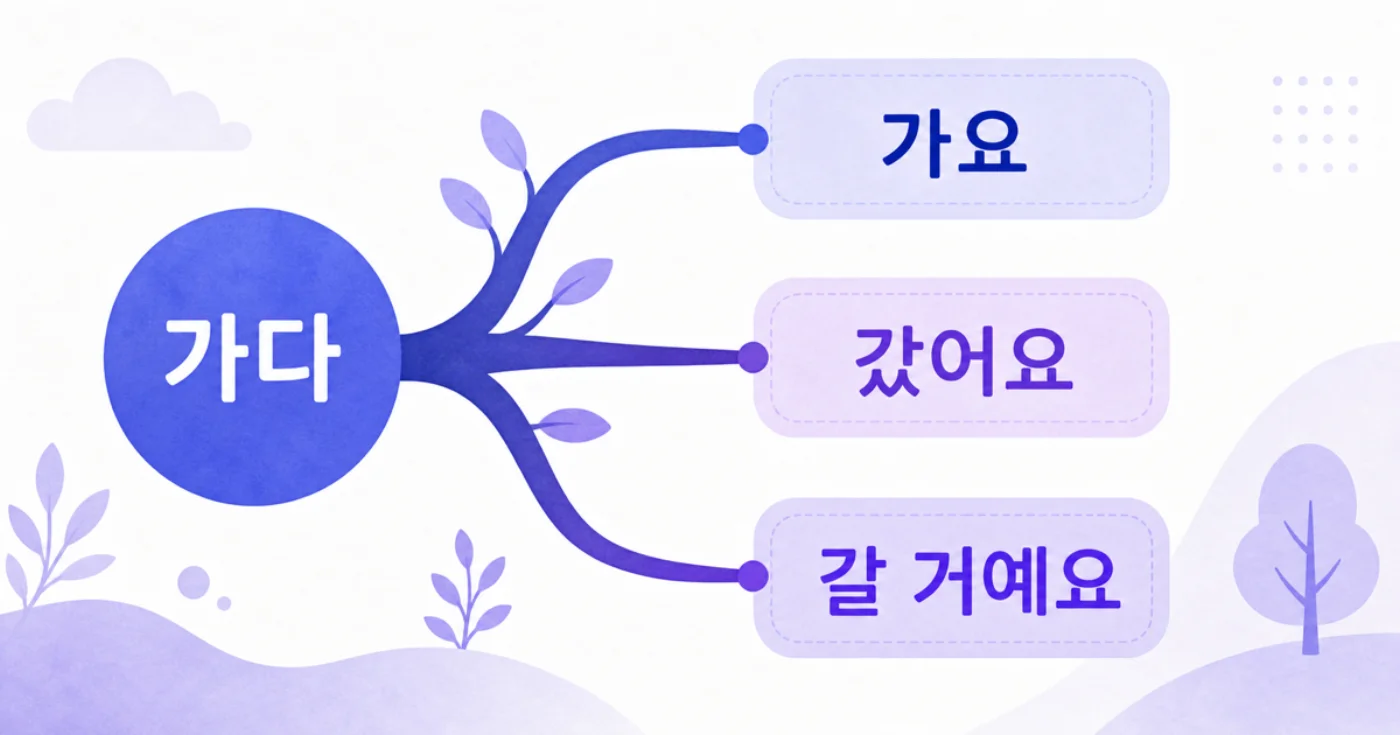
Why Korean Verbs Are Easier Than You Think
If you've studied European languages, Korean verbs might seem intimidating at first. But here's the good news: Korean verbs don't change based on the subject. Whether "I," "you," or "they" does something, the verb stays the same. There's no "I go, you go, he goes" — it's always the same conjugated form. This alone makes Korean verbs far simpler than many other languages.
Korean verbs always come at the end of a sentence, and every verb in the dictionary ends in 다 (da). To use a verb in conversation, you remove 다 to get the verb stem, then add the appropriate ending. Let's break this down step by step.
Step 1: Find the Verb Stem
Every Korean verb has a dictionary form ending in 다. Remove 다 and you have the verb stem. This is the foundation of all conjugation.
| Dictionary Form | Meaning | Verb Stem |
|---|---|---|
| 가다 (ga-da) | to go | 가 (ga) |
| 먹다 (meok-da) | to eat | 먹 (meok) |
| 마시다 (ma-si-da) | to drink | 마시 (ma-si) |
| 하다 (ha-da) | to do | 하 (ha) |
| 보다 (bo-da) | to see | 보 (bo) |
| 읽다 (ik-da) | to read | 읽 (ik) |
| 살다 (sal-da) | to live | 살 (sal) |
| 배우다 (bae-u-da) | to learn | 배우 (bae-u) |
Step 2: The Polite Present Tense (해요체)
The most useful form for beginners is 해요체 (haeyo-che), the polite informal speech level. You'll use this in most everyday conversations — with friends, colleagues, shopkeepers, and anyone you're not being super formal with. The rule depends on the last vowel of the verb stem.
Rule 1: Stem ends in ㅏ or ㅗ → add 아요
Rule 2: All other vowels → add 어요
Rule 3: 하다 verbs → 해요
하다 (to do) is special and incredibly common. Hundreds of Korean verbs are formed by adding 하다 to a noun: 공부하다 (to study), 요리하다 (to cook), 운동하다 (to exercise). All of them conjugate the same way: 하 → 해요.
Quick trick: If the last vowel of the stem is ㅏ or ㅗ, it's "bright" — use 아요. Everything else is "dark" — use 어요. And 하다 always becomes 해요. That covers 99% of present tense.
Making It Negative: 안 and -지 않다
There are two easy ways to make a verb negative. The short form puts 안 before the verb. The long form adds -지 않다 after the verb stem. Both mean the same thing; short form is more conversational.
Formal Polite: -ㅂ니다 / -습니다
For formal situations — presentations, news, speaking to elders you just met, or job interviews — you use the formal polite form (합쇼체). If the stem ends in a vowel, add -ㅂ니다. If it ends in a consonant, add -습니다.
| Verb | Stem | Formal Form |
|---|---|---|
| 가다 (to go) | 가 (vowel) | 갑니다 (gam-ni-da) |
| 보다 (to see) | 보 (vowel) | 봅니다 (bom-ni-da) |
| 먹다 (to eat) | 먹 (consonant) | 먹습니다 (meok-seum-ni-da) |
| 읽다 (to read) | 읽 (consonant) | 읽습니다 (ik-seum-ni-da) |
| 하다 (to do) | 하 (vowel) | 합니다 (ham-ni-da) |
Casual Speech: Dropping 요
With close friends or people younger than you, simply drop 요 from the polite form. 가요 becomes 가, 먹어요 becomes 먹어, 해요 becomes 해. Be careful — using casual speech with someone you should be polite to can be rude.
The 10 Most Essential Korean Verbs
Master these 10 verbs first and you'll be able to express a huge range of ideas. They appear in almost every Korean conversation.
| Dictionary Form | Polite Form | Meaning |
|---|---|---|
| 있다 (it-da) | 있어요 (i-sseo-yo) | to exist / to have |
| 없다 (eop-da) | 없어요 (eop-seo-yo) | to not exist / to not have |
| 가다 (ga-da) | 가요 (ga-yo) | to go |
| 오다 (o-da) | 와요 (wa-yo) | to come |
| 하다 (ha-da) | 해요 (hae-yo) | to do |
| 먹다 (meok-da) | 먹어요 (meo-geo-yo) | to eat |
| 마시다 (ma-si-da) | 마셔요 (ma-syeo-yo) | to drink |
| 보다 (bo-da) | 봐요 (bwa-yo) | to see / to watch |
| 알다 (al-da) | 알아요 (a-ra-yo) | to know |
| 모르다 (mo-reu-da) | 몰라요 (mol-la-yo) | to not know |
있다/없다 (to exist/not exist) are the most versatile verbs in Korean. "커피 있어요?" can mean "Do you have coffee?" or "Is there coffee?" depending on context. Master these two and you unlock a huge range of expressions.
Irregular Verbs: The Tricky Ones
Most Korean verbs follow the rules above perfectly. But a few common verbs have stem changes when conjugated. Don't try to memorize all irregular types — just get used to these high-frequency ones and the patterns will click naturally.
| Type | Dictionary Form | Expected | Actual | Why |
|---|---|---|---|---|
| ㅂ irregular | 덥다 (hot) | 덥어요 | 더워요 | ㅂ → 우 before vowel |
| ㅂ irregular | 춥다 (cold) | 춥어요 | 추워요 | ㅂ → 우 before vowel |
| ㄷ irregular | 듣다 (listen) | 듣어요 | 들어요 | ㄷ → ㄹ before vowel |
| ㄷ irregular | 걷다 (walk) | 걷어요 | 걸어요 | ㄷ → ㄹ before vowel |
| 르 irregular | 모르다 (not know) | 모르어요 | 몰라요 | 르 → ㄹ라/ㄹ러 |
| 르 irregular | 빠르다 (fast) | 빠르어요 | 빨라요 | 르 → ㄹ라/ㄹ러 |
Asking Questions
In polite speech (해요체), questions and statements use the exact same verb form — only the intonation changes. Raise your pitch at the end and it becomes a question. In formal speech (-ㅂ니다), questions change the ending to -ㅂ니까/-습니까.
Practice: Conjugate These Verbs
Try conjugating these verbs into polite present tense (해요체) before checking the answers below. Remember: check the last vowel of the stem to decide between 아요 and 어요.
| Dictionary Form | Meaning | Your Answer | Correct Answer |
|---|---|---|---|
| 읽다 | to read | ___ | 읽어요 |
| 만나다 | to meet | ___ | 만나요 |
| 쓰다 | to write | ___ | 써요 |
| 좋아하다 | to like | ___ | 좋아해요 |
| 살다 | to live | ___ | 살아요 |
| 주다 | to give | ___ | 줘요 |
Next Steps
Now that you understand the basics of Korean verb conjugation, you're ready to learn about tenses (past, present, future) and start building longer sentences. The key is practice — try conjugating every new verb you learn into 해요체 form until it becomes automatic. Korean verb conjugation has very consistent rules, and once you internalize the vowel harmony pattern, it becomes second nature.
Conjugation — Quick Check
1. The verb 가다 (to go) in present-tense 해요체 is:
2. The stem vowel decides 아요 vs 어요. Which verb takes 어요?
Hear the Base Verbs
Conjugation starts from the dictionary form (the -다 form). Tap each base verb below to hear a native speaker, then try conjugating it into 해요체 yourself: drop 다, add 아요/어요, and apply any contractions.
Practice these words with native-speaker audio
Every word is recorded by a native Korean speaker — tap to listen, free and without signing up.
Start Learning Korean Today
Master Hangul in 7 days with interactive lessons, AI conversation practice, and spaced repetition. 100% free to start.
Get Started FreeRelated Articles
Korean Sentence Structure: Understanding SOV Word Order
Understand Korean SOV sentence structure and basic particles. Learn how Korean word order differs from English with clear examples.
Korean Particles Explained: The Essential Guide to 은/는, 이/가, 을/를
Master the most important Korean particles. Learn when to use topic markers, subject markers, and object markers with clear examples and common mistakes to avoid.
Korean Honorifics Explained: Formal, Polite, and Casual Speech
Understand the Korean honorific system: formal (합쇼체), polite (해요체), and casual (해체) speech levels. Learn when to use each with real examples.