Korean Past, Present & Future Tense: The Complete Guide
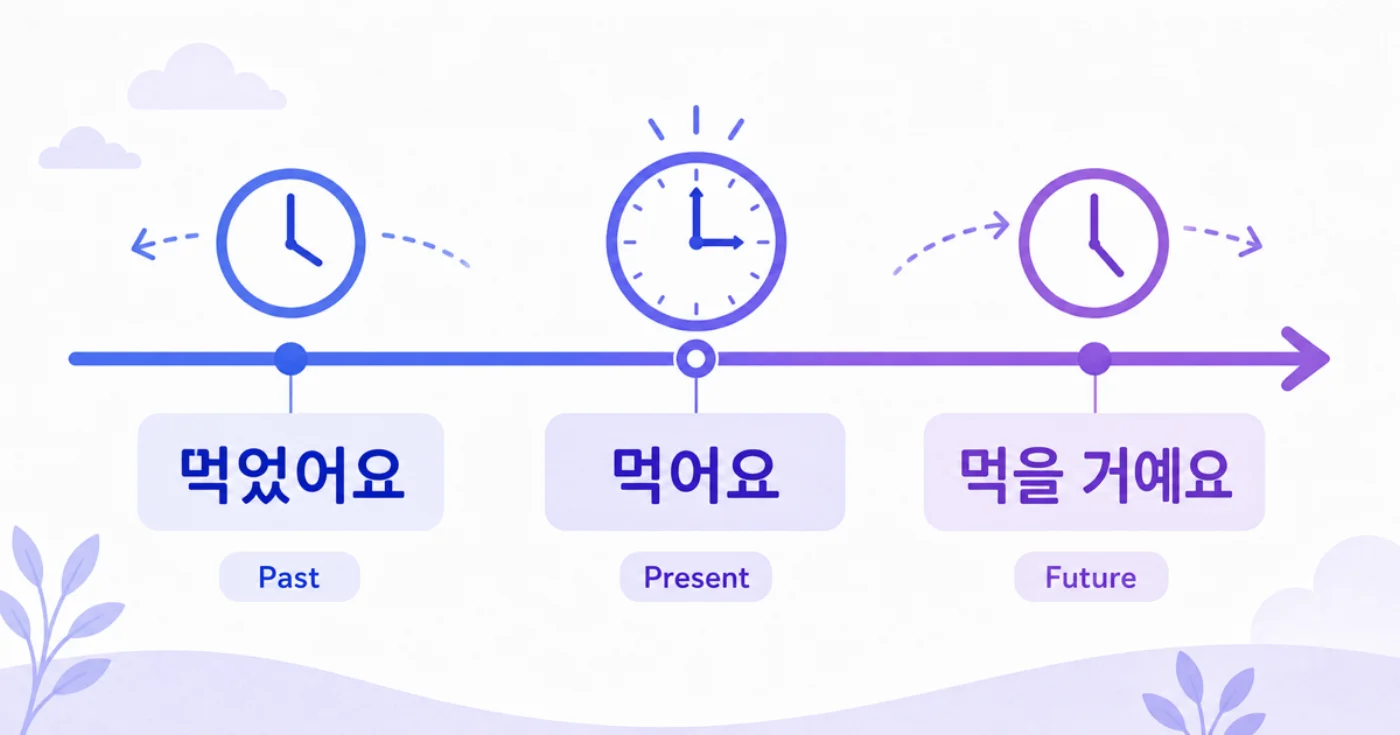
Korean Tenses Are Surprisingly Simple
Unlike English, which has over a dozen tense forms (past simple, past continuous, past perfect, etc.), Korean has just three core tenses. Better yet, Korean tenses don't change based on the subject — "I went," "you went," and "they went" all use the same verb form. If you already know how to conjugate to polite present tense (해요체), learning past and future is just one more step.
Present Tense: -아/어요
The present tense in Korean covers both "I eat" and "I am eating" — there's no separate continuous form in everyday speech. You already know this form if you've learned basic conjugation: remove 다 from the dictionary form, then add 아요 (if the stem's last vowel is ㅏ or ㅗ) or 어요 (all others). 하다 becomes 해요.
Past Tense: -았/었어요
To make the past tense, insert 았 or 었 before 어요. The vowel harmony rule is the same as present tense: use 았 when the stem's last vowel is ㅏ or ㅗ, and 었 for everything else. For 하다 verbs, it becomes 했어요.
| Verb | Present | Past | Rule |
|---|---|---|---|
| 가다 (to go) | 가요 | 갔어요 | ㅏ → 았 → 갔어요 |
| 오다 (to come) | 와요 | 왔어요 | ㅗ → 았 → 왔어요 |
| 먹다 (to eat) | 먹어요 | 먹었어요 | ㅓ → 었 → 먹었어요 |
| 마시다 (to drink) | 마셔요 | 마셨어요 | ㅣ → 었 → 마셨어요 |
| 하다 (to do) | 해요 | 했어요 | 하 → 했어요 |
| 보다 (to see) | 봐요 | 봤어요 | ㅗ → 았 → 봤어요 |
| 배우다 (to learn) | 배워요 | 배웠어요 | ㅜ → 었 → 배웠어요 |
Easy shortcut: Take the present tense form (가요, 먹어요, 해요), remove 요, insert ㅆ as the final consonant, then add 어요. 가요 → 가 → 갔 → 갔어요. 해요 → 해 → 했 → 했어요. This works for almost every verb.
Future Tense: -(으)ㄹ 거예요
The most common future tense form adds -(으)ㄹ 거예요 to the verb stem. If the stem ends in a vowel, use -ㄹ 거예요. If it ends in a consonant, use -을 거예요. This expresses plans, intentions, or predictions.
| Verb | Stem | Future Form |
|---|---|---|
| 가다 (to go) | 가 (vowel) | 갈 거예요 |
| 오다 (to come) | 오 (vowel) | 올 거예요 |
| 먹다 (to eat) | 먹 (consonant) | 먹을 거예요 |
| 하다 (to do) | 하 (vowel) | 할 거예요 |
| 읽다 (to read) | 읽 (consonant) | 읽을 거예요 |
| 마시다 (to drink) | 마시 (vowel) | 마실 거예요 |
| 살다 (to live) | 살 (ㄹ) | 살 거예요 |
Note: If the stem already ends in ㄹ (like 살다, 만들다), just add 거예요 directly — don't double up the ㄹ.
Another Future Form: -겠-
You'll also hear -겠- used for future meaning, but it carries a nuance of strong will, conjecture, or polite intent. It's commonly used in fixed expressions and formal speech rather than casual plans.
All Three Tenses Side by Side
Here's a comparison of all three tenses with common verbs. Notice how consistent the patterns are.
| Verb | Past | Present | Future |
|---|---|---|---|
| 가다 (go) | 갔어요 | 가요 | 갈 거예요 |
| 먹다 (eat) | 먹었어요 | 먹어요 | 먹을 거예요 |
| 하다 (do) | 했어요 | 해요 | 할 거예요 |
| 보다 (see) | 봤어요 | 봐요 | 볼 거예요 |
| 마시다 (drink) | 마셨어요 | 마셔요 | 마실 거예요 |
| 공부하다 (study) | 공부했어요 | 공부해요 | 공부할 거예요 |
| 만나다 (meet) | 만났어요 | 만나요 | 만날 거예요 |
Time Words to Know
Korean sentences often include time words to clarify when something happened. Unlike English, adding a time word doesn't change the word order — it typically goes at the beginning of the sentence or before the verb.
| Korean | Romanization | English | Tense |
|---|---|---|---|
| 어제 | eo-je | yesterday | past |
| 지난주 | ji-nan-ju | last week | past |
| 작년 | jang-nyeon | last year | past |
| 아까 | a-kka | earlier | past |
| 오늘 | o-neul | today | present |
| 지금 | ji-geum | now | present |
| 요즘 | yo-jeum | these days | present |
| 내일 | nae-il | tomorrow | future |
| 다음 주 | da-eum ju | next week | future |
| 내년 | nae-nyeon | next year | future |
| 나중에 | na-jung-e | later | future |
Negative Past and Future
Negation works the same way in all tenses. Just put 안 before the verb, or use the -지 않다 pattern. The tense marker stays on the main verb (or on 않다 in the long form).
Common Mistakes to Avoid
- Don't double-conjugate: 갔었어요 means "had gone" (past perfect), not simple past. For simple past, 갔어요 is enough.
- Don't confuse -겠- with -(으)ㄹ 거예요. Use -(으)ㄹ 거예요 for plans and 겠 for conjecture or formal expressions.
- Time words help but aren't required. Context often makes the tense clear without them.
- Korean present tense can describe habitual actions AND current actions. "밥 먹어요" can mean "I eat rice (in general)" or "I'm eating rice (right now)."
Practice: Convert to Past and Future
Try converting these present tense sentences into past and future. Check your answers below.
| Present | Past | Future |
|---|---|---|
| 학교에 가요 | 학교에 갔어요 | 학교에 갈 거예요 |
| 책을 읽어요 | 책을 읽었어요 | 책을 읽을 거예요 |
| 음악을 들어요 | 음악을 들었어요 | 음악을 들을 거예요 |
| 운동해요 | 운동했어요 | 운동할 거예요 |
| 친구를 만나요 | 친구를 만났어요 | 친구를 만날 거예요 |
What's Next?
With present, past, and future tense under your belt, you can now express when things happen in Korean. The next step is learning connective endings (-고, -서, -면) to join ideas together, and progressive/completion markers (-고 있다, -아/어 있다) for more nuanced time expressions. But for now, practice converting your daily activities into all three tenses — it's the fastest way to internalize the patterns.
Tenses — Quick Check
1. "I ate" — which is the correct past tense of 먹다?
2. How do you say "I will go" (future) from 가다?
Hear It in a Full Sentence
Tenses click once you hear them inside a real sentence. Tap below to hear a native speaker use the future tense naturally, and notice the -(으)ㄹ 거예요 ending in action.
Practice these words with native-speaker audio
Every word is recorded by a native Korean speaker — tap to listen, free and without signing up.
Start Learning Korean Today
Master Hangul in 7 days with interactive lessons, AI conversation practice, and spaced repetition. 100% free to start.
Get Started FreeRelated Articles
Korean Verb Conjugation Made Simple: A Beginner's Guide
How Korean verbs work: from dictionary form to polite speech, with conjugation patterns, stem changes, and the endings you use every day.
Korean Sentence Structure: Understanding SOV Word Order
Understand Korean SOV sentence structure and basic particles. Learn how Korean word order differs from English with clear examples.
10 Common Mistakes English Speakers Make When Learning Korean
Avoid these 10 common mistakes English speakers make when learning Korean. From pronunciation pitfalls to grammar mix-ups, learn how to fix them.