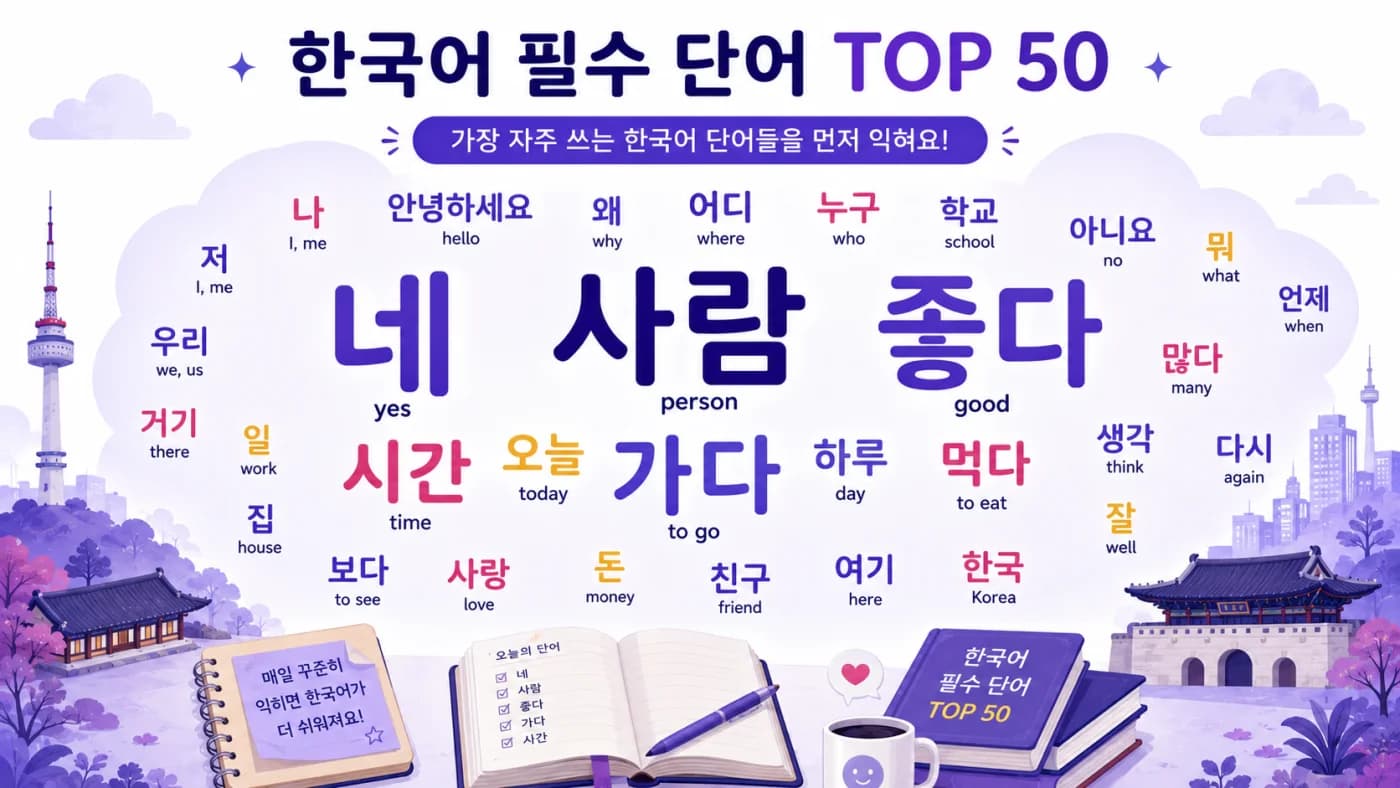
Why These 50 Words Matter
Research in language learning consistently shows that a small number of high-frequency words make up a large percentage of everyday conversation. By mastering these 50 Korean words, you will be able to understand a surprising amount of basic Korean and start forming simple sentences. These words were selected based on frequency in daily Korean conversation, usefulness for travelers and beginners, and coverage across essential categories like people, places, food, and actions.
Pronouns and People
Korean pronouns work differently from English. The words you use depend heavily on your relationship with the person you are speaking to. These are the most essential ones for beginners.
| Korean | Romanization | English | Usage Note |
|---|---|---|---|
| 저 | jeo | I (humble) | Use in most situations; polite form |
| 나 | na | I (casual) | Use with close friends only |
| 우리 | uri | We / Our | Koreans say 우리 나라 (our country), 우리 집 (our house) |
| 이것 | igeot | This (thing) | For objects near you |
| 그것 | geugeot | That (thing) | For objects near the listener |
| 사람 | saram | Person | General word for people |
| 친구 | chingu | Friend | Only for same-age friends |
| 선생님 | seonsaengnim | Teacher / Sir / Ma'am | Respectful title for teachers, doctors, lawyers, and elders — use it to politely address anyone you respect |
Essential Food and Drink Words
Food is central to Korean culture, and knowing these words will help you navigate restaurants, cafes, and convenience stores across Korea.
| Korean | Romanization | English |
|---|---|---|
| 물 | mul | Water |
| 밥 | bap | Rice / Meal |
| 고기 | gogi | Meat |
| 김치 | gimchi | Kimchi |
| 커피 | keopi | Coffee |
| 차 | cha | Tea |
| 빵 | ppang | Bread |
| 과일 | gwail | Fruit |
The word 밥 (bap) means both "rice" and "meal" in Korean. The greeting "밥 먹었어요?" literally means "Have you eaten rice?" but is used like "How are you?" This reflects how central rice is to Korean life.
Places and Locations
Whether you are navigating a Korean city, asking for directions, or talking about where you have been, these place words are indispensable.
| Korean | Romanization | English |
|---|---|---|
| 집 | jip | House / Home |
| 학교 | hakgyo | School |
| 회사 | hoesa | Company / Office |
| 가게 | gage | Store / Shop |
| 식당 | sikdang | Restaurant |
| 병원 | byeongwon | Hospital |
| 역 | yeok | Station (train/subway) |
| 화장실 | hwajangsil | Bathroom / Restroom |
Common Action Words (Verbs)
Korean verbs always come at the end of the sentence. These are the verbs you will use most often in daily conversation. All are shown in their polite present tense form (해요체, haeyoche), which is appropriate for most situations.
| Korean (Dictionary) | Polite Form | Romanization | English |
|---|---|---|---|
| 가다 | 가요 | gayo | To go |
| 오다 | 와요 | wayo | To come |
| 먹다 | 먹어요 | meogeoyo | To eat |
| 마시다 | 마셔요 | masyeoyo | To drink |
| 보다 | 봐요 | bwayo | To see / watch |
| 하다 | 해요 | haeyo | To do |
| 있다 | 있어요 | isseoyo | To have / exist |
| 없다 | 없어요 | eopseoyo | To not have / not exist |
| 알다 | 알아요 | arayo | To know |
| 모르다 | 몰라요 | mollayo | To not know |
| 좋아하다 | 좋아해요 | joahaeyo | To like |
| 사다 | 사요 | sayo | To buy |
Useful Descriptive Words (Adjectives)
Korean adjectives function like verbs and can form complete sentences on their own. "좋아요" by itself is a full sentence meaning "It is good." Here are the adjectives you will encounter and use most frequently.
| Korean (Dictionary) | Polite Form | Romanization | English |
|---|---|---|---|
| 좋다 | 좋아요 | joayo | Good / I like it |
| 크다 | 커요 | keoyo | Big |
| 작다 | 작아요 | jagayo | Small |
| 많다 | 많아요 | manayo | Many / A lot |
| 비싸다 | 비싸요 | bissayo | Expensive |
| 맛있다 | 맛있어요 | masisseoyo | Delicious |
| 예쁘다 | 예뻐요 | yeppeoyo | Pretty |
| 재미있다 | 재미있어요 | jaemiisseoyo | Fun / Interesting |
Time and Frequency Words
These time-related words appear in nearly every Korean conversation. They help you talk about when things happen and are essential for making plans.
| Korean | Romanization | English |
|---|---|---|
| 오늘 | oneul | Today |
| 내일 | naeil | Tomorrow |
| 어제 | eoje | Yesterday |
| 지금 | jigeum | Now |
| 매일 | maeil | Every day |
| 항상 | hangsang | Always |
Time words in Korean usually come at the beginning of the sentence, before the subject. "오늘 저는 학교에 가요" (Today I go to school). This is opposite from English, where time often goes at the end.
Power Words for Daily Survival
Finally, here are the glue words that hold conversations together. These appear constantly and knowing them will help you understand Korean even when you do not catch every word.
| Korean | Romanization | English | Usage |
|---|---|---|---|
| 네 | ne | Yes | Also used as "I see" or "I'm listening" |
| 아니요 | aniyo | No | Polite form of no |
| 그리고 | geurigo | And / And then | Connects sentences |
| 하지만 | hajiman | But / However | Shows contrast |
| 왜 | wae | Why | Question word |
| 어디 | eodi | Where | Question word for places |
| 뭐 | mwo | What | Casual form of 무엇 (mueot) |
| 얼마 | eolma | How much | Essential for shopping |
How to Study These 50 Words Effectively
Memorizing a word list is not enough -- you need to use these words actively to make them stick. Here is a proven approach to building vocabulary that lasts.
- Learn 5 new words per day, not all 50 at once -- spaced repetition beats cramming
- For each word, learn it in a sentence, not in isolation -- context creates stronger memories
- Practice saying each word out loud -- Korean pronunciation needs muscle memory
- Label objects in your home with Korean sticky notes (집, 물, 빵, etc.)
- Review yesterday's words before learning today's new ones
- Use the words in real conversations or write simple diary entries in Korean
- Group words by situation (ordering food, asking directions) rather than alphabetically
- Track your progress with HangeulMate's spaced repetition system to review at optimal intervals
The 80/20 rule applies to language learning: roughly 20% of Korean words account for 80% of everyday conversation. These 50 words are part of that critical 20%. Master them thoroughly before expanding your vocabulary further.
Top Words — Quick Check
1. A waiter asks if you want more water. You are full. What do you say?
2. How do you ask "Where is the restroom?"
Hear the Words in Action
Vocabulary sticks when you hear it used. Tap each everyday question below to hear a native speaker, then practice saying it -- these are real sentences you can use the moment you land in Korea.
Practice these words with native-speaker audio
Every word is recorded by a native Korean speaker — tap to listen, free and without signing up.
Start Learning Korean Today
Master Hangul in 7 days with interactive lessons, AI conversation practice, and spaced repetition. 100% free to start.
Get Started FreeRelated Articles
15 Essential Korean Greetings Every Beginner Should Know
Master the 15 most important Korean greetings from formal to casual. Learn when and how to use each greeting with pronunciation guides.
Korean Numbers: Complete Guide to Native and Sino-Korean Systems
Learn both Korean number systems: native Korean (하나, 둘, 셋) and Sino-Korean (일, 이, 삼). Understand when to use each system with practical examples.
Korean Family Terms: 오빠, 언니, 형, 누나 Explained
Confused by oppa, unnie, hyeong, and nuna? These Korean family terms switch with your gender, not theirs. Learn it with native audio, a chart, and a quiz.