Korean vs Japanese vs Chinese: Key Differences for Language Learners
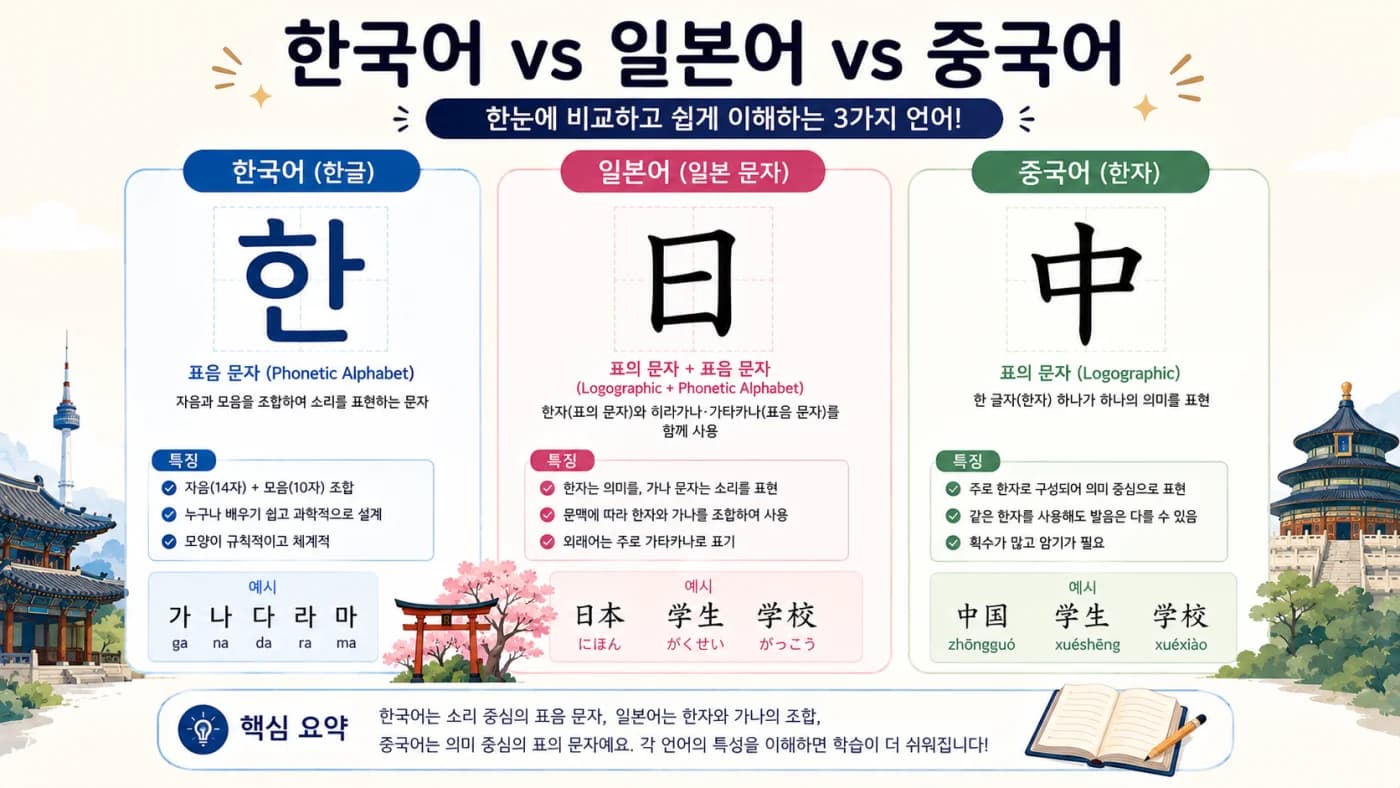
Korean, Japanese, and Chinese are often lumped together as "the East Asian languages," but that convenience hides how different they actually are under the surface. They use three unrelated writing systems, two radically different grammar families, and tone systems that range from four distinct tones (Mandarin) to none at all (Korean). This guide compares them across writing, grammar, pronunciation, vocabulary overlap, and realistic time-to-proficiency — so you can choose the language that matches your goals instead of the one with the loudest marketing.
Writing Systems: The Biggest Difference
The writing system is where these three languages differ most dramatically. This single factor has a huge impact on how quickly you can start reading and writing.
Korean: One Alphabet (Hangul)
Korean uses Hangul (한글), a phonetic alphabet with 14 basic consonants and 10 basic vowels. Letters are grouped into syllable blocks, but each symbol consistently represents one sound. You can learn to read Hangul in a matter of hours, even if you do not understand the words yet. There are no characters to memorize beyond the 24 basic letters and their combinations.
Chinese: Thousands of Characters
Chinese uses logographic characters (汉字 / 漢字, hanzi). Each character represents a meaning and a syllable, but you cannot guess pronunciation from the character shape alone (with some partial hints from phonetic components). Literacy requires knowing approximately 3,000 to 4,000 characters. Mandarin Chinese also uses Pinyin (a romanization system) as a learning aid, but the characters are essential for reading real-world text.
Japanese: Three Scripts Combined
Japanese uses three writing systems simultaneously: Hiragana (ひらがな, 46 characters for native words and grammar), Katakana (カタカナ, 46 characters for foreign loanwords and emphasis), and Kanji (漢字, Chinese-origin characters — about 2,136 in the standard set). A single Japanese sentence can mix all three scripts, making the writing system the most complex of the three.
Writing System Comparison
| Feature | Korean | Japanese | Chinese (Mandarin) |
|---|---|---|---|
| Script type | Alphabetic (phonetic) | Mixed (2 syllabaries + logographic) | Logographic |
| Characters to learn | 24 basic letters | 2,228+ (hiragana + katakana + kanji) | 3,000-4,000+ |
| Time to read basics | Hours to days | Weeks to months | Months to years |
| Romanization system | Revised Romanization | Romaji | Pinyin |
| Spaces between words | Yes | No | No |
Korean is the only one of the three that uses spaces between words and has a fully phonetic alphabet. This makes it significantly easier to start reading and looking up words in a dictionary.
Grammar Structure
Korean and Japanese share remarkably similar grammar. Both use Subject-Object-Verb (SOV) word order, postpositional particles, and agglutinative verb conjugation. Chinese grammar is closer to English in some ways, using Subject-Verb-Object (SVO) order and relying on word order rather than particles.
| Feature | Korean | Japanese | Chinese |
|---|---|---|---|
| Word order | SOV (I apple eat) | SOV (I apple eat) | SVO (I eat apple) |
| Particles | Yes (은/는, 이/가, 을/를) | Yes (は, が, を) | No (word order matters) |
| Verb conjugation | Extensive (tense, mood, politeness) | Extensive (tense, mood, politeness) | Minimal (time words instead) |
| Honorific system | Complex (7 levels) | Complex (keigo, 3 types) | Minimal |
| Plural markers | Optional (들) | Optional | None (context-based) |
| Articles (a/the) | None | None | None |
Pronunciation
Pronunciation difficulty varies significantly between the three languages, and different aspects are challenging for English speakers.
Korean Pronunciation
Korean has a three-way consonant distinction (plain, aspirated, tense) that does not exist in English. For example, ㄱ (g/k), ㅋ (k with strong aspiration), and ㄲ (kk, tense) are three separate sounds. Korean also has vowels like ㅓ (eo) and ㅡ (eu) that have no English equivalent. However, Korean is not tonal — meaning does not change based on pitch.
Chinese Pronunciation
Mandarin Chinese has four tones (plus a neutral tone). The same syllable pronounced with different tones means completely different things. For example, mā (mother), má (hemp), mǎ (horse), and mà (scold) are all distinct words. Tones are often the biggest hurdle for English speakers learning Chinese.
Japanese Pronunciation
Japanese pronunciation is generally considered the easiest for English speakers. It has only five vowel sounds (a, i, u, e, o), no tones, and most consonants are similar to English. The main challenges are pitch accent (subtle but less critical than Chinese tones) and the distinction between long and short vowels.
| Aspect | Korean | Japanese | Chinese |
|---|---|---|---|
| Tones | No | Pitch accent (subtle) | Yes (4 tones + neutral) |
| Unique consonants | 3-way distinction (ㄱ/ㅋ/ㄲ) | Few unfamiliar sounds | Retroflex (zh, ch, sh) |
| Vowel difficulty | ㅓ, ㅡ unfamiliar | Simple (5 vowels) | ü is unfamiliar |
| Sound changes | Many (linking, nasalization) | Few | Tone sandhi |
Shared Vocabulary: Sino-Korean Words
One surprising connection between the three languages is shared vocabulary from Chinese origin. About 60% of Korean vocabulary and a similar proportion of Japanese vocabulary comes from Chinese characters (called 한자/hanja in Korean and kanji in Japanese). These words often sound similar across all three languages because they derive from the same Chinese roots.
| Meaning | Korean | Japanese | Chinese |
|---|---|---|---|
| Library | 도서관 (doseo-gwan) | 図書館 (toshokan) | 图书馆 (túshūguǎn) |
| Student | 학생 (haksaeng) | 学生 (gakusei) | 学生 (xuéshēng) |
| Family | 가족 (gajok) | 家族 (kazoku) | 家族 (jiāzú) |
| Telephone | 전화 (jeonhwa) | 電話 (denwa) | 电话 (diànhuà) |
| Promise | 약속 (yaksok) | 約束 (yakusoku) | 约束 (yuēshù) |
If you already know some Chinese or Japanese vocabulary, you have a head start in Korean. Many Sino-Korean words are recognizably similar once you learn the sound correspondences.
Difficulty Comparison for English Speakers
The US Foreign Service Institute (FSI) classifies all three as Category IV languages — the most difficult for English speakers — requiring approximately 2,200 class hours to reach professional proficiency. However, the specific challenges differ.
| Factor | Korean | Japanese | Chinese |
|---|---|---|---|
| Reading barrier | Low (learn Hangul fast) | High (3 scripts) | Very high (thousands of characters) |
| Grammar complexity | High (verb endings, particles) | High (similar to Korean) | Lower (simpler structure) |
| Pronunciation | Moderate (no tones) | Low (simple sounds) | High (tonal system) |
| Writing | Moderate (syllable blocks) | High (3 scripts, stroke order) | Very high (character memorization) |
| Getting started | Fastest | Moderate | Slowest |
Which Should You Learn First?
There is no single right answer — it depends on your goals and motivations. But here are some practical considerations:
- Choose Korean if: You want the fastest start with reading and writing, enjoy K-pop or K-dramas, or plan to visit South Korea. Hangul removes the character memorization burden entirely.
- Choose Japanese if: You are into anime, manga, or Japanese gaming culture, or plan to work in Japan. Be prepared to invest significant time in learning kanji.
- Choose Chinese if: You want the most widely spoken language (1.1 billion speakers), are interested in business in China, or want a foundation that helps with both Korean and Japanese vocabulary.
- Learning one helps with the others: Korean and Japanese share grammar structure. Korean and Chinese share vocabulary roots. Any of the three builds a foundation for the others.
The Korean Advantage
Among the three, Korean offers a unique advantage for beginners: you can learn to read within your first week. With Hangul, you immediately unlock the ability to sound out any Korean word, even if you do not know the meaning yet. This creates a positive feedback loop — you can practice reading signs, menus, and song lyrics right away, which keeps motivation high during the challenging early months of language learning.
Whichever language you choose, the most important factor is sustained motivation. Pick the language connected to the culture, media, or people you care about most. If Korean is calling to you, the writing system gives you one of the smoothest on-ramps of any Asian language.
Hear the Hangul Advantage
The clearest way to feel why Hangul is easier is to hear a word and see how directly it maps to its letters. Tap below: each sound matches its written form, with none of the character memorization that Chinese or Japanese demand.
Quick Check: Korean vs Japanese vs Chinese
1. What is the biggest writing-system advantage Korean has for beginners?
2. Which of these languages is tonal?
3. A shared feature of Korean and Japanese grammar is:
Ready to experience the Hangul advantage? HangeulMate teaches you the complete Korean alphabet in Level 0 with audio, pronunciation practice, and interactive quizzes — so you can start reading Korean in your very first session.
Keep practicing with native-speaker audio
Every word is recorded by a native Korean speaker — tap to listen, free and without signing up.
Start Learning Korean Today
Master Hangul in 7 days with interactive lessons, AI conversation practice, and spaced repetition. 100% free to start.
Get Started FreeRelated Articles
What Is Hangul? The Complete Guide to the Korean Alphabet
Discover Hangul, the Korean alphabet created by King Sejong in 1443. Learn why it's considered one of the most scientific writing systems ever invented.
Korean Sentence Structure: Understanding SOV Word Order
Understand Korean SOV sentence structure and basic particles. Learn how Korean word order differs from English with clear examples.
Is Korean Hard to Learn? Honest Answer + What Makes It Easier Than You Think
Is Korean hard to learn for English speakers? We break down what's easy, what's challenging, and how long it actually takes with a practical study plan.